139:40:35 Evans (onboard): Hey, finally got a gray. Okay. Image Motion is On.
139:40:41 Evans (onboard): Mapping Camera, On, - 40 - 41 at 3-minute - [garble] it run for 5 hours, anyhow. So, Mapping Camera, On. Barber pole, plus 3. There's one right there. [Coughing] [Laughing]
Evans (onboard): What the heck is that? [Laughing] My tone booster floated over in front of the Sun. Kind of scares the heck out of you.
Evans (onboard): Must be in the wrong window - maybe not.
Evans (onboard): [Coughing]
Evans (onboard): Aitken's going to be out of the other window. Out of window 5, yes.
Evans (onboard): [Coughing] [Humming]
139:45:35 Evans (onboard): Okay. I guess window 3 is the best one after all. You see it coming up.
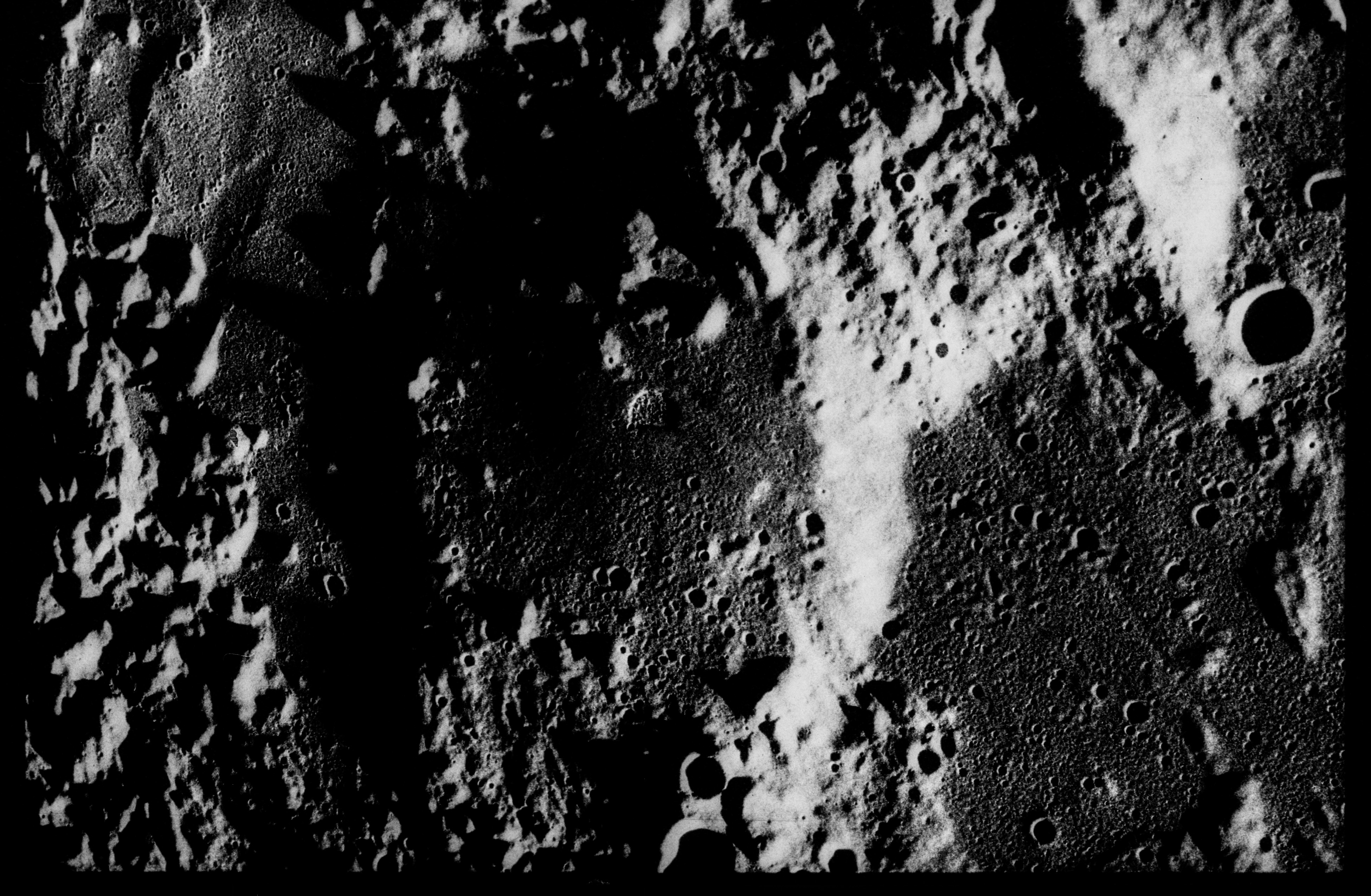
Evans (onboard): Little bit of glare out the window, but not bad. Aitken is about two crater diameters from the - from the terminator on this rev. And being close to the terminator, you can look around the general terrain - around the whole area. It's pretty well subdued. There are spots as - what I call plains-flow-type material. The reason I call it plains-fill material as opposed to a lava flow is because the crater population seems to be considerably more - considerably higher in these areas. And, the areas I'm speaking of primarily are just to the east of Aitken and also to the north in some of the low-lying valleys. Try to pick up some sort of flow lines or anything around it. Don't see any this time around on the - on the plains-flow-type material around the edges. Looking at the general edge of the crater Aitken itself, you don't see any positive elements as an ejecta blanket or ray material. There aren't any around. However, the rims, slumping within the rims, particularly on the west wall, is considerably apparent. It is somewhat subdued, so it is probably - oh, Eratosthenian somewhere in that area, late Eratosthenian as opposed to Copernican. When you look down in the floor itself, there are some light-colored swirls. I guess is the common terminology for it. From this particular angle, in here, I can't see any apparent relief or texture to the floors themselves.
139:46:XX Begin Lunar Rev 27
139:48:13 Evans (onboard): In this case, all the swirls seem to be running from west to east, or east to west, as the case may be. They seem to be essentially lined up in that way, like they had blown across and maybe gone around - a low mound or something like that. Concentrating on the cloverleaf - and I'll call that cloverleaf - in the northeastern corner down there, the biggest apparent thing is there, it's quite obvious, that you have lava scarp flowing up and over the - in front of the slump material that has been slumped down inside the crater, at least some of the original base fill. So the lava flow's definitely after that, and it looks like in one area - in what I'll call the south domical structures down there, there's a graben or a flow graben where it has flown - Well, I can't tell if it is in or out of. I am just losing sight of it, now. I'll have to check that out next time around. But I can't tell if it is flowing in or out, but at least it's a breach. There has been a lava flow, either into or out of the south domical feature.
139:49:45 Evans (onboard): There are several, you know, there are subdued craters of some kind, completely subdued or maybe still in that type craters in the north - right south of what we call Crater A. Even there, with the shadow of - Sun angle of, oh, must be no more than 10 degrees, or something like that, or maybe a little bit more. But, you can't see down through that shadow. The western rim is very hard. You lose their shadow down there, and you can't see through the shadow at all.
Evans (onboard): But, in summary, the most significant thing about the crater Aitken, is the fact you have a recent mare flow, and the fact that you can see the flow lines, or the flow scarp - least, on the eastern interior of the crater. In Champlin [sic] there's a little - little turtleback-type crater in there - what I call a turtleback-type crater floor. And there seems to be a few of these on the back side; but not too many. Oh, maybe four or five, as I can recall right now. But, in each case, there's kind of a trough, or I guess you might call it a rille - except it is a D-shaped trough is what it is - all the way around the crater between the crater wall and the interior. Just like the interior is kind of bounded up in some sort of discus form. And, you know, it was eased up and maybe subsided back a little bit on the thing to create the turtleback-type of a texture. However, I can remember some of the dacite flows out in California, you get that same type of appearance from a high altitude standpoint.
139:51:59 Evans (onboard): They look like a rough - well, relatively smooth - turtleback-type of texture on the thing from a high altitude then, when you get down clo - get down low, they were, of course very rough-type of a terrain. But it looks smooth from a high altitude. There is Chaplygin - Chaplygin - with the Star of Chaplygin. The Star of Chaplygin, of course, is a very bright crater on the northeast rim of Chaplygin. You know, something that is very interesting to me is the fact that several craters of the - oh, 30-kilometer size - yes, about the 30-kilometer, about the size of Crater A in Aitken. And they're all relatively fresh-type craters, and they don't have any - no real apparent eJecta blanket, except the interior slopes are smooth. They have fairly sharp corners at the top of the rims. And near the bottom they have a flat floor of some kind, and some of the floors have, you know, it is a definite sharp contact - sharp-angle change from the floor to the wall. It is hard for me to visualize how you could have something sloping down the side of a crater and proceed out in a - in a horizontal floor.
139:56:13 Evans (onboard): And then in other craters of about that size, and also that age regime, you'd almost - think that they were from mare-type floor, because the - the color of the material in the floor is essentially the same as the surrounding terrain.
Evans (onboard): Okay. We're passing Marconi now.
Evans (onboard): Dellinger and Pannekoek coming up.
Evans (onboard): Oh, my! Mendeleev is really a big old basin up there.
140:00:00 Evans (onboard): [Garble] Crater Panner - Pannokek - Pannekoek, or something like that, next to Dellinger has a turtleback-small turtleback - 30-kilometer crater inside of it. And then on west of that, there's a recent type crater - I say recent again, because it has a smooth, sloping interior rim - and - but again with no ejecta blanket. And also, the northwestern slope of that particular crater, you can see - it has to be a flow slide, ss the type of material has gone down into it. The [garble] comes strictly from the rim, all the way down to the crater floor.
Evans (onboard): There's a tremendous crater chain or something going off in the northwest direction. It goes south of Rutkin [?] right next to Bečvář. No, that can't be right.
Evans (onboard): Negative. I said that last thing - the crater chain is there, but I can't figure out for sure where it is [chuckle]. Oh, okay. Here's Love, so - it's just north of Love Crater. There's [garble] Gregory. Echo [?] is a big basin that is pretty obvious to see. Roosa [?] Crater is right on the rim of it. Bečvář is down in the middle. And then - on the edge of Bečvář - on the edge of Bečvář is another relatively recent, but not as good - not as recent as Roosa [?].
140:03:41 Evans (onboard): Roosa [?] has all different colors of - material on the thing. Light material down in the walls itself and from the - about the upper one-eighth or something like that, you can see - it almost looks greenish from here, at this particular Sun angle. That's a greenish-type layer, all the way around the top and presumably there's a great big monstrous block of some type. And you can see that greenish-type material - there's a slump - slump fault on the southern edge of Roosa [?], and you can see that greenish - a hint of that greenish-type material at the top of that slump mark also.
140:04:41 Evans (onboard): Sure funny - the way those things fall off back down there and - although in the case of Roosa [?] it's quite apparent. You can see herringbone, hummocky-type material, or ejecta blanket, all the way around it. It covers up all the way across Bečvář and every place else. You can see it all over the place. But it sure seems to be a heck of a lot of the material falling back in the middle, somehow. They usually start out as a small - smaller craters and just keep caving in, or something. There has got to be some big blocks down there. There you can see the crater King. On across there - and coming across the Arabia now. Looking out across the horizon you can see that it's away. Yes, it's Just a wide spot where Creek - where King is, I think, - especially to the north of King and to the south of King. It's a little bit higher than it is to the west. There's a little bit of a plateau - even a crater diameter from King off to the northeast. You can see Labachevsky clear up on the horizon now. And there's some sort of a - a greenish, - again, in this sunlight to me it looks kind of a greenish - a greenish tint to it anyhow. I don't have my sunglasses on either, by the way. The [garble] flow is all - There's a fresh crater - about a crater diameter south of King. That's maybe 20 kilometers in diameter. It's obviously an impact-type crater. But again, you have the dark-greenish layering around the top of the crater. And maybe it extends for about one-eighth of the crater depth. And then you can see some hint of the green - greenish or darker-type material down at the bottom of the crater floor.
140:07:52 Evans (onboard): I think you would have to be quite a bit lower than I am, right now, in order to really pick up - from among all these craters here. This thing here, I guess you, could see a typ - topographic rise over Saenger.
Evans (onboard): I can't get over the curvature. In this attitude, it really shows up. As I come across Rayley [?] here, I keep looking for a swirl. And I can see a definite type of clusters. The only thing - It's an awful high Sun in here to really see any swirls. Now, there is something coming up over the wall of Labachevsky. Yes, it looks like a lighter swirl-type material and then - Let's see - to the west - southwest of Lobachevsky it looks like a heck of a lot of swirl-type material in that area.
140:12:00 Evans (onboard): And the albedo's - a light - dark - I guess what I'm trying to say is, they are almost ray-type of expression. I don't see any topographic expressions; especially the one that goes down - down in the crater and also to the south as the one between Chang Heng and Labachevsky. Rooster Tail [?] is a very bright subcrater. The ejecta blanket - it goes all over the place, scattering rays eight to l0 - eight to l0 crater diameters from it. And...
140:13:16 Evans: ...it as well as the - some of the more Eratosthenian craters around Saenger. Looks to me like you can still have a little bit of a hint - at least of the layering, or a broken-up different-colored material at the top of all these craters.
Evans: And supposed to stop and rewind the DSE. Forgot to do that.
Overmyer: Roger, Ron. We'll take care of the DSE.
Evans: Okay. Okay, I'll let you do it.
Overmyer: Roger, Ron.
Evans: [Garble]. Okay.
Evans: Okay. I took three, or four, pictures on mag OO up to frame 104 kind of looking north across the Arabia.
Overmyer: Roger, Ron. We copy.
Overmyer: Ron. Just some words for you. We placed...
Evans: Okay, kind of a - Okay, go ahead.
Overmyer: No, go ahead - go ahead with yours. We don't want to interrupt.
Evans: I was just going to say that on the crater Aitken, on the other side, is probably - there are no - no - rays - visible rays that I can see at the low Sun angle, anyhow, coming across there. There's definitely a mare floor in there. It's a dark albedo-type - flat floor. There's swirls in it; no definite expression of swirls. One thing that's quite apparent, you have a flow scarp in the northeast corner of it coming out of - oh, a little cloverleaf-type of an area there. I'm going to have to look the next pass over it to see if, on account of the south domical structure that's in there, it's breached. And I can't tell if the flow of material is flowing to the east out of that domical structure or if the flow is flowing into the domical structure. I ought to take a better look at that the next time around.
140:17:11 Overmyer: Roger. We got you. See any lava marks on the crater rims, there?
Evans: Well, that's - that's the - the lava mark is what I'd call - is almost a lava scarp - in - up in the northeast corner. There are some lava marks along the central peak. They aren't nearly as apparent as the one up in the northeast corner. The northeast corner is definitely a flow front - a lava flow front, that has flown up the - the old interior wall of the crater.
Overmyer: Roger, Ron. What's the color of the dome in Aitken?
Evans: Well, the color of the dome in Aitken is - the colors are hard to - to visualize - the color of the dome is essentially the same as, as - pretty much the surrounding material around there. Maybe a little bit lighter - a little bit lighter than the surrounding material. Of course it's definitely lighter than the floor. The floor itself, to me, has a tan - had a tan to it.
Overmyer: Okay, Ron. We'll have to break away here a second. Pan Camera Mode to Standby.
140:18:41 Evans: Okay.
Overmyer: If you haven't got your Flight Plan, it's Pan Camera Mode to Standby, then Power On.
140:18:55 Evans: [Garble]. Okay, Power is going On.
Overmyer: Okay, Ron. And it's time to charge battery A and we'll cue you on the Pan Camera Power Off. Okay, that should have been deleted. We've already charged the bat A, so...
140:19:17 Overmyer: How about the freshness of the wall and ejecta materials, and the brightness of the rim deposits on Aitken while we have a minute here.
Evans: Okay. The brightness of the rim deposits are a little bit brighter than the surrounding area on the thing. The way that you put it, probably early Eratosthenian. It's definitely not Copernican because I can't see - well, at least in that low Sun - I can't see any rays - any rays around it. But probably late Eratosthenian - somewhere in that area because you have the slumping - Well, it's not subdued at all. The walls themselves - of the crater are not subdued. They're fairly fresh - not as fresh as Copernican. And - and I just can't remember whether we had the - seems to me like it was brighter at the higher Sun angles around there, which indicate that there would still be some remnants of a - of a bright ring around it.
Overmyer: Okay, Ron. And whenever you're ready, Pan Camera Power to Off.
140:20:35 Evans: Pan Camera Power is going Off.
Overmyer: And we're with all eyes here waiting for a Crisium-Serenitatis visual.
Evans: [Laughter.] Okay.
Overmyer: Anything at all, Ron, while we've got an open area, anything you want to say - we're following you on the map - just sing out.
Evans: Okay.
Overmyer: Ron, while you're thinking here a second, do you have any views on the possible origin of the domes in Aitken?
Evans: Well, I'm pretty sure they've got to be volcanic in origin. That's what - that's what it looks like to me anyhow. And especially if I can determine that the material in the northeast corner of Aitken has flown out of that domical little structure in there.
140:22:51 Evans: You know something - the observation that I think is pretty significant is the fact that most of the 30-kilometer craters on the back side of the Moon seem to be fairly fresh. And any of them that are fresh - by fresh I mean you don't have any real definite ray pattern to them, but you've got a real smooth - not smooth but streaked straight - slope, 45-degree angle going down into the crater and the crater wall. And then you get down to the bottom of the crater, and you got a flat floor down there or sometimes there is a domical type of a floor. And the domical material down there doesn't resemble anything like the stuff that's slumped down the side.
Overmyer: Okay, we copy. Ron, if you're handy, you might hit Error Reset on the DSKY. It looks like you might have hit a Mark button or something.
Evans: [Garble]. Yeah, might have hit the Mark button.
Overmyer: That - that makes it.
Evans: Okay. I just got used to the other attitude, and now I'm at a different attitude. [Laughter.] [Garble] attitude, though.
Overmyer: Rog. Understand. Rog. Are you able to pick anything up on Crisium yet?
140:24:37 Evans: No, just now coming up on Crisium. I just now see it out of window 5. Just off the southern edge. Let me try window 3; I think it might be better.
Overmyer: Okay; you might remember we're looking for the colored tones, the shades between units up on Crisium, and we're looking for location of color boundaries relative to the mare ridge system.
140:25:10 Evans: Okay, I'm looking at the eastern edge of Crisium now. As you come across there, it looks there might be - a little bit darker - You know, I keep seeing browns all the time up here instead of grays - gray tones. Maybe that's just the way I interpret them. They are - to me kind of a brownish tint to them, and it's a darker brown than the - the stuff to the - to the south of the ridge system there.
Overmyer: Roger. Ron, our data would show that CM5 might be a better window.
Evans: Take a look at that one. Yeah, it's a little better. Looking straight down. I'm just now passing that crater I took a picture of on the last time - of the pass on there. And instead of having a round bottom, it's got a diamondshape fill in the bottom. And the diamond, itself, is about - oh, a half of the crater diameter. And this is on the south rim of Crisium.
Overmyer: Okay. We copy. Does the ridge system cross the color boundary, Ron, in Crisium?
140:26:52 Evans: Well, this ridge system is running east and west down here. The color boundary isn't nearly as apparent in Crisium as it is in Serenitatis. Except that right under me right now there's kind of a subdued crater-type thing and with a southern part of a ridge. The ridge runs east - west, and it looks like we've got a flow coming out of it. Let me see if I can get a quick picture of that one. Well, lost my camera [laughter]. Here it is. Oh, it's too late; it's gone now. You know something, you see this subsolar point, it's kind of - zero phase - zero phase point, I mean, is following me right along out here in Crisium, so I get a different color straight out from the window than I do out from the edge of it. So I think that's going to influence my thinking.
Overmyer: Rog, Ron. How does color of Picard - the rim deposits on Picard compare to the surrounding mare material there?
140:28:35 Evans: Okay. The color on Picard is - is definitely darker. It's got a darker rim, darker material that goes out to - oh about a half a crater and some points extending out to a crater diameter. And then from the south arcing around to the west to - to the northwest corner, you got some light-colored material on top of that.
Overmyer: Is any of that tan or brown?
Evans: It's kind of a - the darker material I'd call tannish-gray. More gray than tan. In other words, the whole mare, itself, I'd consider kind of a - kind of a light tan. And then the type of material, the dark material that's flowing out - that's thrown out - is kind of a tannish-gray.
Overmyer: Okay. In the inner appearances of Picard, for color variations, can you determine different units based on color and flow characteristics?
140:29:42 Evans: Yes, you can. In the area where you have the white thrown out on top, you essentially got a - as - as you go down the crater wall, you've got a white streak that goes all the way around it, and then you've got a dark layer underneath that. And then a white layer on below that.
Overmyer: Rog. Are you saying the color zones are concentric?
Evans: Yeah, the color zones are concentric going around.
Overmyer: Beautiful. How about the central peak material to that of the crater walls?
140:30:30 Evans: Well, the central peak material is - you know, it's more smooth-type stuff. This stuff in the crater walls is - fine, straight sloping, except where it's slumped down. Where it's slumped down, it's just kind of piled up - a jumble of - type stuff, you know?
Overmyer: Roger.
Evans: You know, in the crater nearest over there has the same color distinction around it for - out for about a crater diameter, except it doesn't have any of the light material on it at all.
Overmyer: Okay, Ron, we might direct your attention to the dark halo craters in the western Mare Crisium. Are they impact or volcanic in origin?
Evans: You can see some of the rays from the crater Proclus have spread out all the way across here. And they completely cover up the ridge system that goes around there, so I can't see any color distinction on the eastern - or on the western edge of Crisium.
Overmyer: Roger. We copy. How about those dark halo craters? Are they volcanic in origin?
140:31:40 Evans: Some of the - Ah, I was looking at the volcanic - or the dark-rimmed craters, and some of them have what I'd call a - an ejecta pattern around them; and the others just have kind of a raised rim with no apparent blocks. The one to the west - let's see, southwest - of that little V that sticks out there by Yerkes - that hill that sticks out there by Yerkes - now, that's the one that, to me, looks like it has an ejecta pattern around it with blocks. It's about a - oh, a thousand-meter crater.
Overmyer: Roger. Got it. Oh that crater that you mentioned was a flow pattern, will you be sure and make a mark on your map on that, please? We're really interested in that.
Evans: Okay.
Overmyer: Should be coming up on Macrobius by now, aren't you?
140:33:07 Evans: Yes, I can just barely see Macrobius. And - [garble] it be better out of window 3.
Overmyer: Okay. We're standing by.
Evans: I'm looking for any dark-halo craters in - I was looking for any dark-halo craters in this area that might be sticking through the Proclus rays. Well, you know, you compare on either side of the Proclus ray, though, and the same size crater rather [garble] Tranquillitatis or the - the moundy stuff before you get to Tranquillitatis are really underneath Coper - the - the Proclus ray. You get the same albedo of ray material from the small craters in either case.
Overmyer: Roger. We understand.
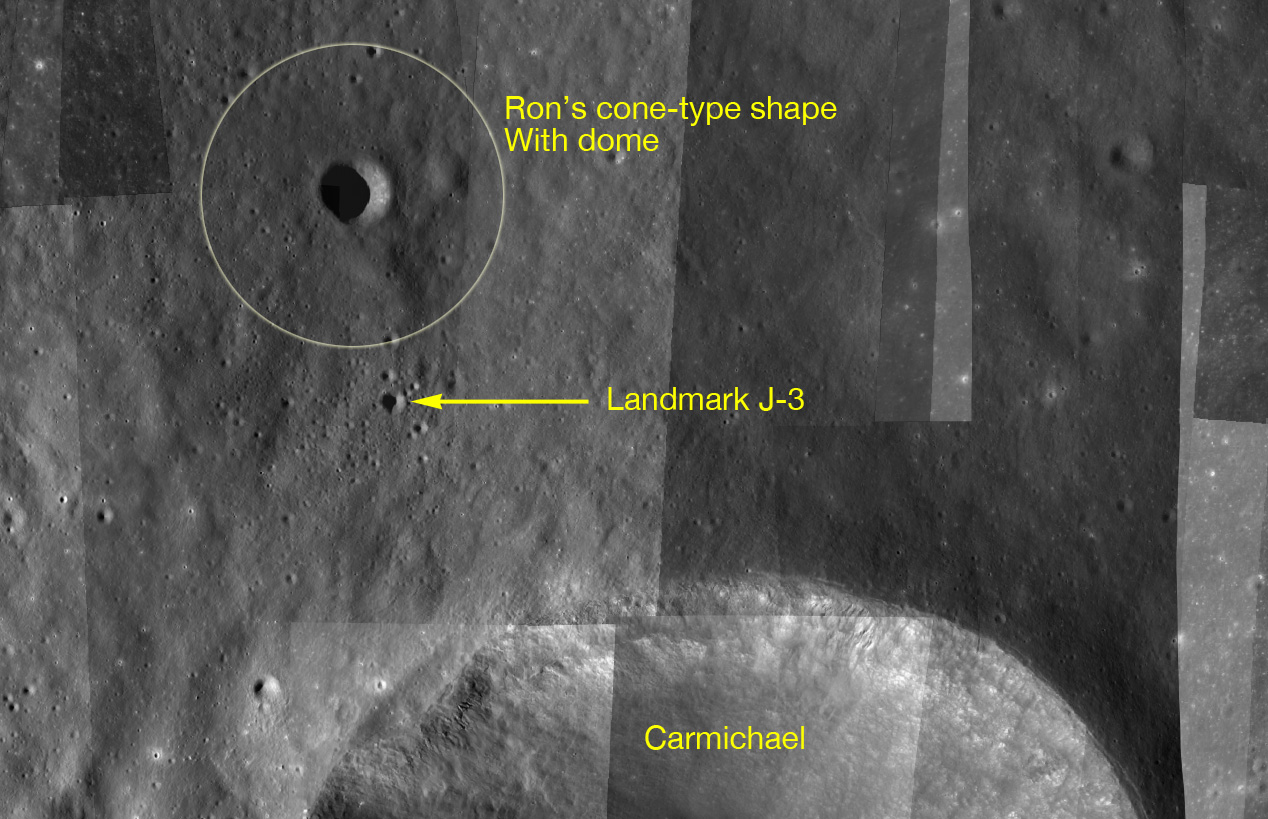
140:34:12 Evans: Oh, here's a Macrobius A and B. Course, J-3 is up there. The two dark craters - well, the one just - north, I guess, of Macrobius A, and also north of J-3 - now that's the one that has the dark mound around it. It's got a small dome down in the center. It - it doesn't have any ejecta pattern around it - you know, no rays, no nothing. To me, that looks like - it sure looks like a cinder cone to me. You get that same type of feeling. The dark halo that goes around it goes out for at least a crater and a half diameter. The raised dome down in the center of the crater is about a fourth of a crater diameter. And there are no rays. And it has a dark halo.
140:35:59 Overmyer: See any color tones on that crater at all, Ron?
140:36:05 Evans: Yeah, the color on that particular - color of that is the same color as you see in Maraldi and as you see in the - the landing site. And that is what I - what I consider the dark - tannish - tannish-gray type of material. And again, the fresh craters around Maraldi still look kind of bluish to me, not as much as they did yesterday, but they still look kind of a - have a bluish tint to them from the reflection of the Sun. In other words, they are fresh craters and they are about the size of - one of them is about the size of MOCR, and the other one is about the size of Sherlock or Camelot.
Overmyer: Okay. You're around Maraldi now [garble]...
Evans: [Garble] same way. Yeah, I'm still on Maraldi. Yeah.
Overmyer: Okay...
Evans: I was on Maraldi, and...
Overmyer: How about comparing the floor fill of Maraldi to the light plains in Maraldi E?
Evans: Go ahead - The floor fill in Maraldi is definitely a darker color. The light plains in Maraldi E are the - the light-tan material. And Maraldi - The floor of Maraldi looks just like the landing site.
Overmyer: How about the color, tone, and texture of Maraldi Gamma?
140:37:39 - America is over the landing site now.
140:37:44 Evans: Okay. Maraldi Gamma looks just like the rest of all of the surrounding hills around there. I think that's just a - some of the - what do you call it, the Sculptured Hills type of material that has been - was high and has been inundated by mare flow at one time or another. It had - mare flows kind of come up around it.
Overmyer: Okay. How about the domical hills inside of Vitruvius A, as compared to Aitken?
Evans: Okay. I just missed that one. We'll have to get that one on the way by.
Overmyer: Okay.
140:38:23 Evans: Next time I guess. Right now, I'm looking at the ridge system around the annulus of Serenitatis. And the dark material stops before you get up to - Oh, what's the crater that sticks into the side of Serenitatis and sticks out beyond the eastern edge of Serenitatis? Anyhow, the dark material stops before you get to there. The dark material only goes up to - let's see - There's a definite rille. There's a wrinkled ridge and at the east of the wrinkled ridge, there are two craters, about 20 kilometers in diameter. And then farther east of that is the - the rille. A graben, it looks like that goes up - and that's about the extent of the dark area that's the same as the - the same material as the landing site.
Overmyer: Roger. We copy.
Overmyer: Okay, Ron. That - that completes the visuals on this pass. We - if you want to look some more, we've got some time. We do have some Flight Plan camera PADs and all that, but no hurry on any of it.
Overmyer: We do have some attitude changes...
Evans: ...continue looking here until we pass - oh, do you need an attitude change now?
Overmyer: No, that's not until 46. We got some time on that. It's a Verb - change of Noun 78.
Evans: Okay. Give me a clue about a minute ahead of that.
Overmyer: Yeah, I'll do that, Ron. Just keep talking.
140:40:09 Evans: Okay. We're in the Tacquet area now, and in this case, the wrinkled ridge system that's out in the middle does not make a change in the color boundary. The color boundary is completely out to the outer edge and is - in the area of those - the rilles. Those are - There's kind of arcuate rilles, straight rilles, and in the Tacquet, yesterday, I said this was Sulpicius Gallus, but it's Tacquet - Tacquet area, but [garble]...
Overmyer: Roger, Ron. Can you give us a color difference between the dark mantle and the mare at this Sun angle?
140:41:07 Evans: Yeah, the color difference - again the - You know, I just - I just now noticed that when I get down at this Sun angle, out in front of me, I got one color, and then I look straight down and I have a different color. But in this Tacquet area, you've definitely got some cinder cone type - No, I don't want to say cinder cone, but anyhow - volcanic. And it almost looks like a breached cinder cone right next to - I think it's Melrose [?] - is the name of that - that crater - the big one that's right on the edge of Serenitatis. I'll find it on the map and mark it for sure. But just to the east of that, it sure looks like a breached cinder cone in - in - in one of those rilles down there. And then that type of material is - is - kind of a dark tan in - at this Sun angle. And it's definitely darker than the - than the Serenitatis Basin material.
Overmyer: I think it's Tacquet is the name of that crater. Isn't it, Ron?
Evans: Tacquet is the little one, and then - then there's a bigger one right next to Tacquet.
Overmyer: Okay. Menelaus is just to the east of Tacquet there.
140:43:04 Overmyer: Hey, Ron, I - I blew that. Menelaus is west of Tacquet up there.
Evans: Yeah, Menelaus, that's the one.
Overmyer: Any textural difference between the dark mantle in the site and the Sulpicius Gallus formation, Ron?
Evans: Yes, there is.
Overmyer: Would you attribute it to the actual ground or would you attribute it to possibly the Sun angle difference?
Evans: I think, I would attribute it really to the - to the actual ground. I guess what I am going to have to do is really wait until the Sun angle gets a little bit higher there in that Tacquet region to answer that for sure. But it seems to me like the - the material in the landing site area is - is more smooth, you know, or smoother than what's in the Tacquet region. That part in the Tacquet region seemed to me like it was - is - It's just a rougher-looking-type material. You know, not - not massive. Hey. There's D - D-Caldera. Hey, what do you know?
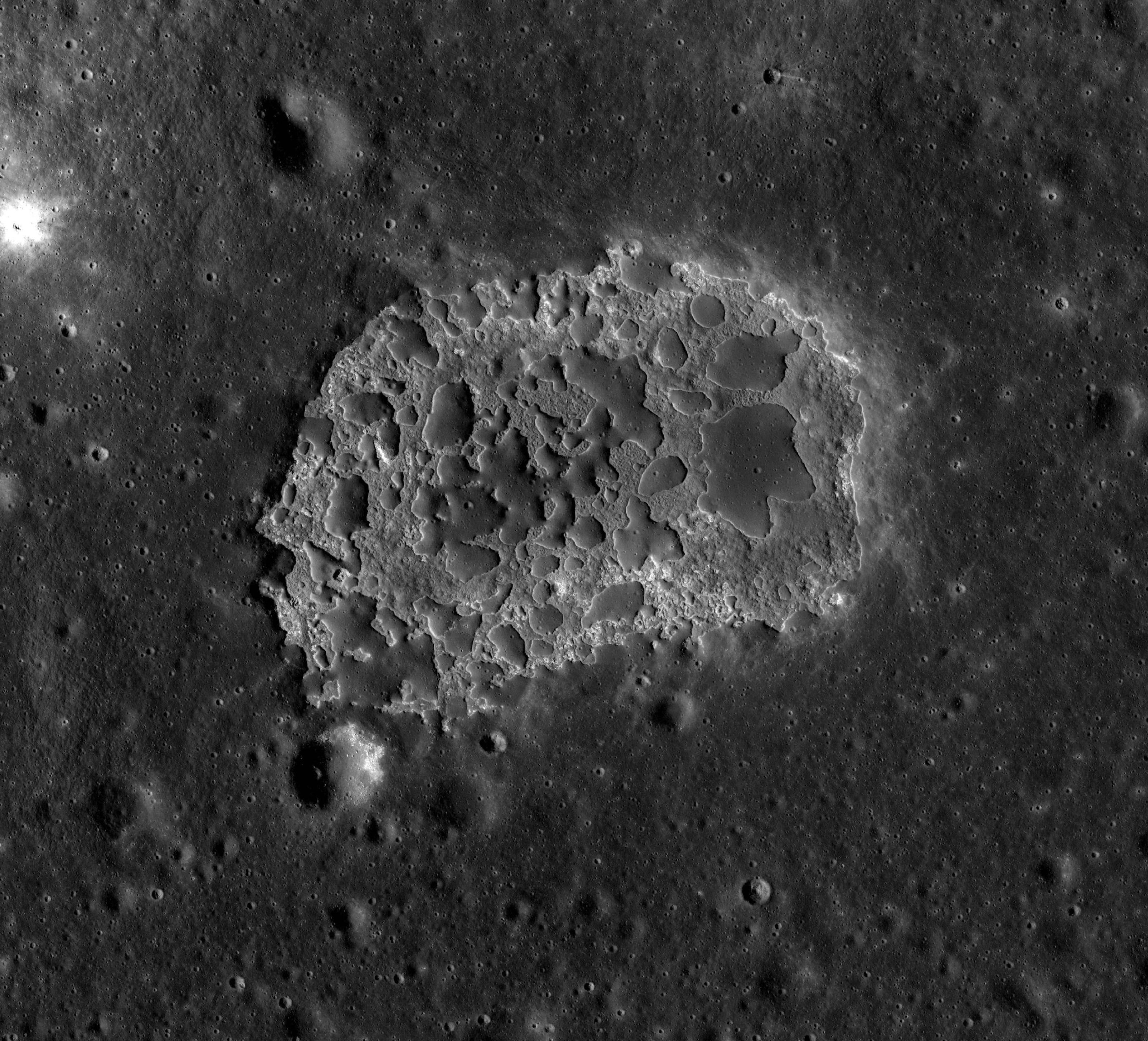
The feature referred to as the D-Caldera is now named Ina. It is an unusual area of the Moon, shaped like the letter 'D' and it lies within Lacus Felicitatis. First discovered in photographs from Apollo 15, it is about 3 kilometres long and 2 kilometres wide.
LROC context image of lunar feature Ina - Image by LROC/ASU.
140:45:06 Overmyer: Do you have - do have any dark - do you have any dark halo craters near Sulpicius Gallus?
Evans: Yeah. The - I'll be darned.
Overmyer: We're - we're with bated breath, waiting.
Evans: [Garble]. Picture 28 of D-Caldera with the Hasselblad. I mean with the Nikon [laughter], and the Sun angle must be about 1 or 2 degrees.
Overmyer: Roger. We copy.
Evans: You know, I really didn't concentrate too much on - on Sulpicius Gallus at that - that particular passing, I was concentrating on the Tacquet area, and in that - in that case, all of the - the rilles and the ridges - not the wrinkle ridges out in the middle out in there, but the rilles and the area built up around the rilles and also associated maybe - Oh, I was going to say 10 times the will - the rilles width is all one color.
Overmyer: Okay, Ron. We'd like High Gain to Auto, and we'd like to load your Noun 78.
140:46:41 Evans: Okay. High Gain to Auto. Let me see, 22 Noun 70 to Enter. Okay. Let's see, plus 52.25. plus 52.25. Up-link. Verb 58 Enter. [Garble]. Proceed to [garble] gets out of the way. Okay. D-Caldera was taken on picture number 28. It was f/8 at 1/500, and then I took three more before that. They're terminator photos, looking north across Sulpicius Gallus and farther north. And they were 1/500 at f/16 to start with and then f/11.
Overmyer: Roger, Ron.
Evans: That's probably about all I'm allowed, I think, on this XX film.
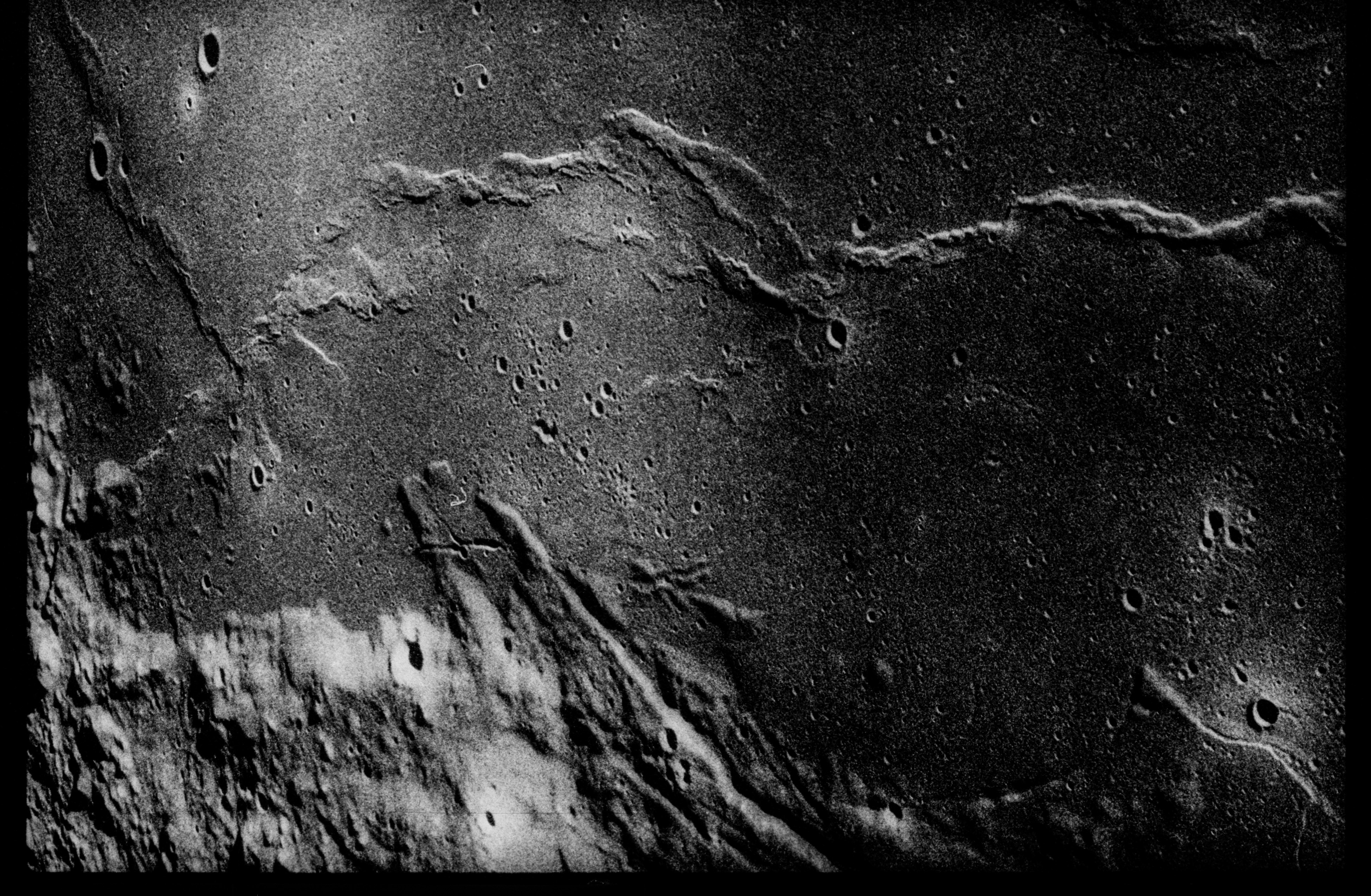
AS17-159-23928 - Dorsum Buckland and Rimae Sulpicius Gallus, southwest Mare Serenitatis - Image by NASA/Johnson Space Center.
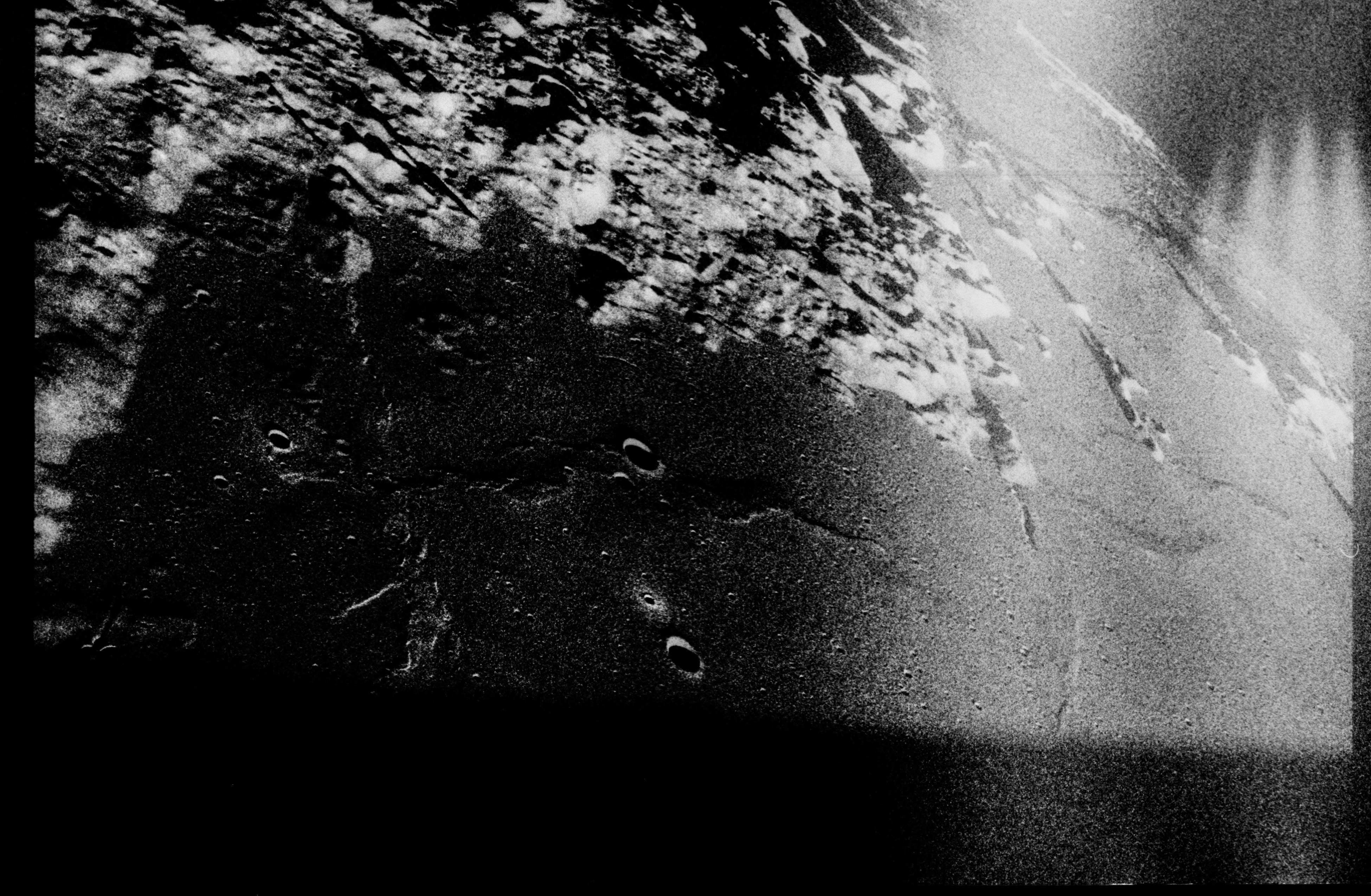
AS17-159-23929 - Western Mare Serenitatis including craters Aratus C and D - Image by NASA/Johnson Space Center.
AS17-159-23930 - Western Mare Serenitatis including craters Aratus C and D and Dorsum Gast - Image by NASA/Johnson Space Center.
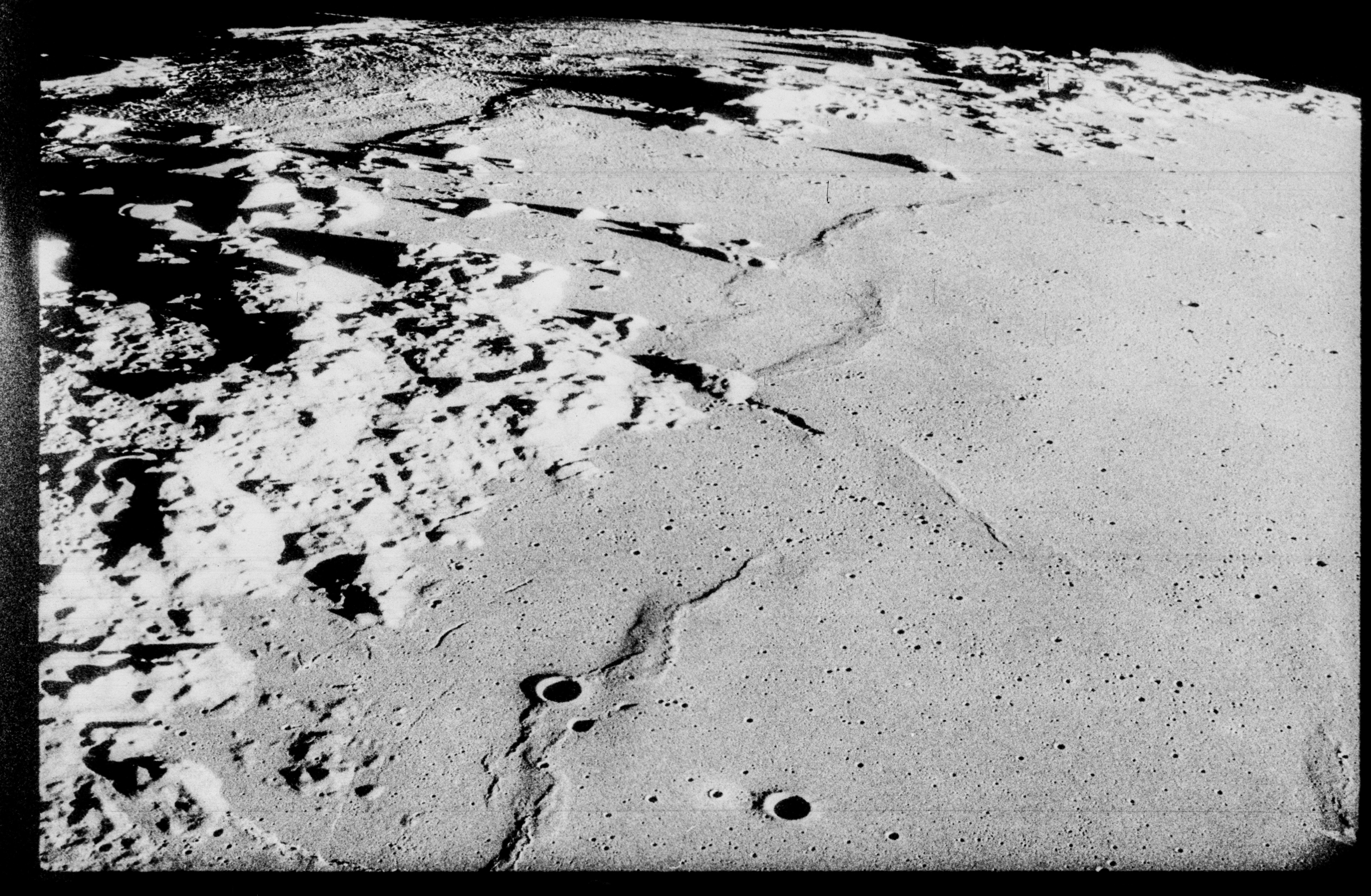
AS17-159-23931 - Lacus Felicitatus, including Ina (D-Caldera) in the centre of the image - Image by NASA/Johnson Space Center.
Overmyer: What was your last frame number on XX, Ron?
Evans: Yeah, that was - I'm on number 29 now.
Overmyer: 29. Roger. You're on 29, right here.
Evans: Say, on magazine Oscar Oscar, did we get enough of our required photos out of that, or are the rest of those - opportunity or not?
Overmyer: We'll check on that with FAO, Ron. I do have one Flight Plan update for you on the Pan Camera photo PAD. But you first ought to go to the Image Motion, Increase, barber pole plus four steps, to On, and Laser Altimeter, On.
Evans: Right now, you mean?
Overmyer: Yeah, it's - it's time, Ron. It's time for that.
140:49:35 Evans: Okay. Image Motion - let's see - I think that was barber pole plus three before. There it is. 3 - 4...
140:49:56 Evans: Laser Altimeter, On.
Overmyer: Okay, Ron. That Pan Camera...
Evans: I hope to pick up some answers to some of those things on a couple more passes. Okay. That's right. Go ahead.
Overmyer: Okay. Did - did it bother you, me - me reading some of those questions to you? I know you'd probably had time to study them, hut I thought I'd jog your memory on them.
Evans: Oh, no. That's - no, that's good. I appreciate it.
Overmyer: Okay. I'll get a conference here with Farouk before we start the next pass on the next rev around and see if we can improve it. Things worked perfect down here. We - I had the questions in front of me, and Farouk flipped them into the screen and it really worked great.
Overmyer: Okay, Ron...
Evans: Yes. That's good, okay.
140:50:44 Overmyer: ...at 141:50, I've got the Pan Camera photo PAD.
Evans: Okay. Ready to copy.
140:50:54 Overmyer: Okay. T-start time, 141:54:01; T-stop time, 142:18:24.
140:52:37 Overmyer: Ron, just for your information, we're playing back the voice playback from the last rev, and it'll be recorded in house. It is readable, and we can read it.
Evans: Oh, okay. Good. I purposely tried to keep one of the microphones right on my mouth on those things. I don't know if that helps or hinders it.
Overmyer: Rog, Ron...
Evans: At least I could hear myself talk that way.
Overmyer: Rog. It worked. We can read it, and somebody can listen to it here when we get a chance. How about on this back side of this next rev? Looks like you're pretty busy with some PADs and - and some photo work in there. Do you expect to be doing any recording - much recording there?
Evans: No, probably not. I'll just try to - try to make notes of it or something, and then pass it on out when I come out the other side.
Overmyer: Good show, Ron. Good show.
140:54:07 Overmyer: And your - your grounded friends down there are busy working around the LM right now and doing some loading the Rover and that, getting ready for the EVA-2 work. They're out on the surface and loading the Rover.
Evans: Very good. I'll be glad to - curious to know if they can make it up that hill or not - to Scarp.
Overmyer: Rog.
Evans: Looks like they should be able to go right up that valley, the way they've got it planned there.
Overmyer: Gene's got to take some time here on this EVA and make a fender. We're - we're piecing together a couple of maps and trying to get a fender, because they lost a piece of the fender last night.
Evans: [Laughter.] They did, huh?
Overmyer: We're going to give Gene his auto mechanic's license if it works.
140:54:57 Evans: How's my - yeah, right. How's my ZPN? All I did was move it. I didn't put in a new sensor yet. Do I need to put on a new sensor?
140:57:34 Overmyer: Ron, the ZPN data isn't too good. It's the sensor sponges need to be replaced, if you didn't already replace them.
Evans: [Laughter.] Thought I'd get by without replacement. Yeah, I'll replace them pretty quick.
Overmyer: Hey - you know - your choice. We can - we can stand the crew exercise period without replacing them, I'm sure.
Evans: Okay. While I was eating my peanut butter awhile ago, I lost my lobster bisque and my juice. And I just now found it.
140:59:08 Overmyer: Okay, Ron. Here's your word on some magazines here. X-ray X-ray has to be left for the Zodiacal light. You - you should not take any more on X-ray X-ray until after Zodiacal light. Mag Oscar Oscar and Papa Papa are yours to play with, as long as you stay with the Flight Plan on the rest of the mags.
Evans: Okay.
Overmyer: And those are your crew options for the rest of the mission, those two mags.
Evans: Okay. In other words, we made it up on Oscar Oscar, I guess, on that one pass, huh? Rest of them are - are crew options.
Overmyer: Roger.
Ron has left his microphone live to Earth and he can be heard exercising.
141:11:47 Overmyer: Hate to say it, because it's very dead serious work, but I'm kind of watching a lunar comedy as the - the two lunar stalwarts are trying to plan the new fender on the vehicle down there.
Evans: [Laughter.] I'll bet that's really no easy job, you know.
Overmyer: That's right. They've got a couple of their clamps - what they did is they...
Evans: [Garble] kind of hard.
Overmyer: They took a couple of their clamps, and they took - taped together in the cockpit a couple of their big lunar maps - the big heavy maps - and they're - now they're clamping that map to the fender where the removable part is.
Evans: Oh, I see. Must be pretty dusty down there or something.
141:12:33 Overmyer: Yeah. Well, they lost a fender, and it was throwing dust up on Gene. It's just ridiculous how much dust they got on them, so they - they just decided they just had to go ahead and do something.
Evans: Yeah.
Overmyer: I would hate to be paying for that fender repair job by the minute.
Overmyer: Oh, that was me - went off on the wrong loop, - loop there, Ron.
Evans: Oh, okay. [Laughter.] Okay.
Evans: On that Crisium Serenitatis - number 4 of 5 - that - dark dome just to the northwest of J-3 - the one I was talking about that had the typical cone-type shape with the dome down in the side of it.
Overmyer: Rog. We had it. Farouk had a pointer on it the whole time. I knew just what you were talking at.
Evans: Yeah. Okay. Okay.
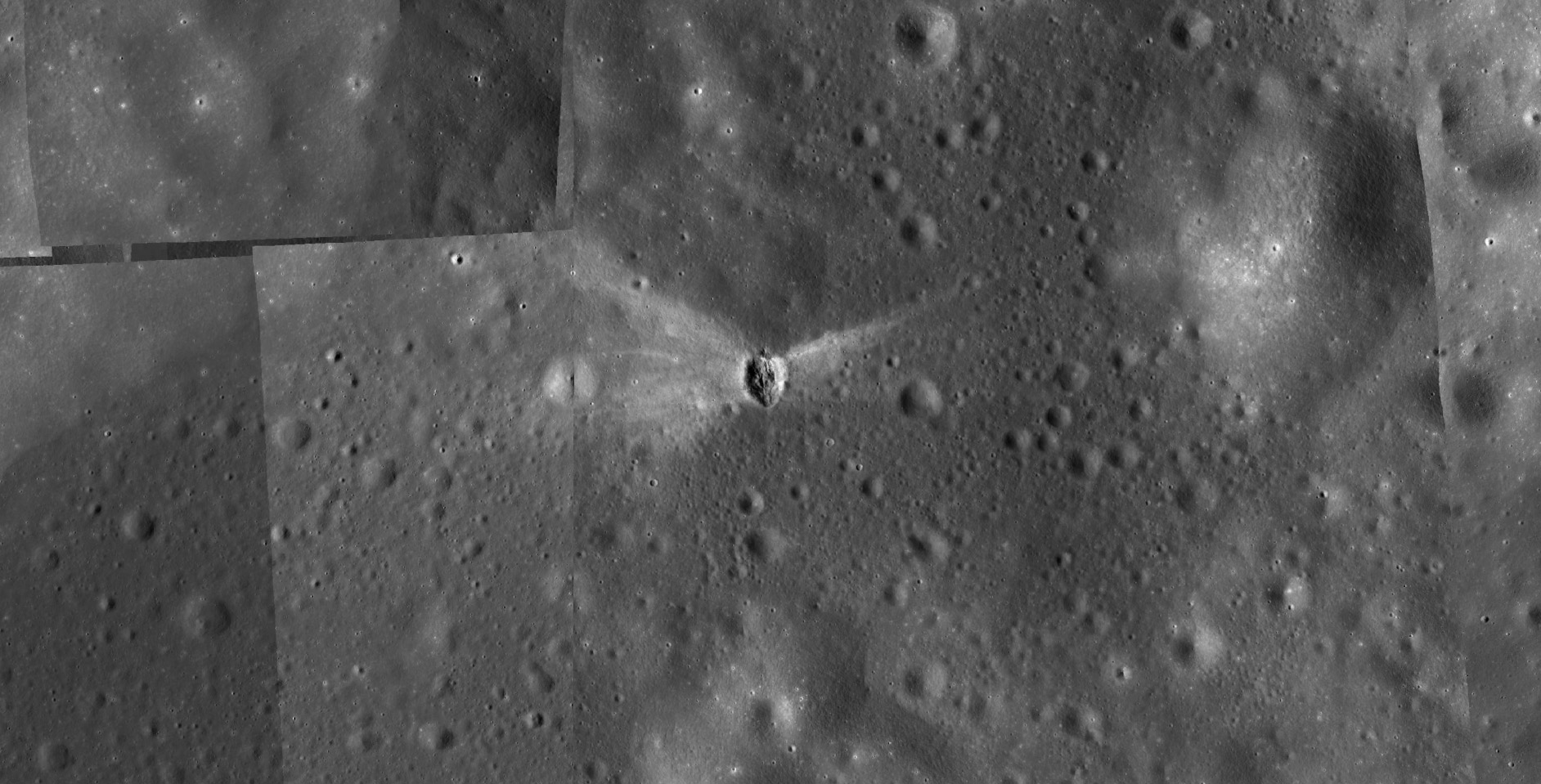
Based on imagery from the Lunar Reconnaissance Orbiter, Ron is likely referring to a 1.6-kilometre crater north of J-3 that has a distinctive dark halo. It also has a dome about a kilometre east of the rim. LRO measurements indicate that the summit of this dome is higher than the crater rim.
1.6-kilometre dark-halo crater near landmark J-3.
A similar dark halo will be sampled by the surface crew at Shorty Crater 4.5 kilometres from the landing site. This is where the crew discovered orange soil but another result from Shorty was that its dark halo was ejected material from the crater's formation dug up from the subsurface by the impact.
141:20:45 Overmyer: Just talked to the home front a little while ago, and everybody's fine, Ron. And they were able to get the squawk boxes squared away, so she should have been listening to you for last couple of passes - all on the [garble]. The problem was it wasn't able to shut off one loop or the other, so today we've been - they've been able to get all - just the CSM loop in there for - during the AOS periods.
Evans: Oh, I see. Otherwise, they - they were both coming in, huh?
Overmyer: Yeah. Last night, they were both coming in. Today, they got it squared away, so you're just coming in, and they are able to watch and listen to the other one on - on the TV channel there.
Evans: Yeah. TV, yeah. Uh huh.
Overmyer: And they say they're looking forward to good weather tomorrow. Supposed to finally get a break in this stuff tomorrow.
141:21:38 Evans: Hey, good. We can say that's because the guys went to the Moon, see?
Overmyer: Rog. Okay [laughter].
Evans: [Garble] get the good break's in the weather [laughter].
141:21:56 Overmyer: About 5 min - 4½ minutes to LOS now, Ron. We went around the room, and all systems look good and you're just looking great.
Overmyer: That's great. We noticed your heart rate went up pretty well on the exercise. Looks like you got some exercise, and we'll be seeing you at 142:12.
Evans: 42:12. Okay.
Overmyer: And we'll be all set up with our backroom for those orb science visuals from Copernicus on down to Reiner Gamma; and you know, [garble] too, but we'll be up for all - everything in between. So, just standing by for your word.
Evans: Okay.
Overmyer: And Stu's mentioned if you hadn't earlier, that you might try the binoculars when you look at Copernicus for that dike you said - if you hadn't thought of it before.
Evans: Yes. I'm going to try that this time.
141:22:54 Overmyer: Okay. Good show.
Very long comm break.
141:44:XX Begin Lunar Rev 28
141:49:10 Evans (onboard): Okay; I just passed over - the - Crater Aitken again. That flat domical feature down there, especially, had a flow that's come out of that feature out into the flat maria trough. You can see the flow channel - going out, and then also, right in the breach right on the side of it, there is a second flow that has come out on top of the breach. And it stopped right in the breach itself.
141:50:03 Evans (onboard): Okay; there's 50. Pan Camera to Standby - Stereo - and - Power. Camera to Operate.
141:51:15 Evans (onboard): Okay. For the record there, mag Oscar Oscar took three pictures, one with an 80 and two with a 250 lens, and the exposures are now 106, I guess.
141:57:54 Evans (onboard): Keep losing my maps.
142:07:04 Evans (onboard): [Humming]
142:11:19 Evans (onboard): [Garble] all right.
Evans (onboard): There's [garble] on the recorder.
142:13:13 Evans: There's the ole Earth. It's about a half Earth now.
Evans: Houston, America.
Overmyer: Go ahead, Ron.
Evans: Okay, Robert. I guess the big thing I want to report from the back side on this one here is that I took another look at the - the Cloverleaf in Aitken, with the binocs, and that southern, domical crater of the Cloverleaf - it has a breach on the east - east side of it. It - I can't tell - There's - there's a flow - In other words, the domical structures, themselves, are part of a flow material that has partially filled up the breach. In other words, the breach has either flowed into that little domical structure before the domes were built, or else all of that stuff that's in the mare floor has flown out of that domical structure before the domes came in. In other words, the domical structures, themselves, are different time relationship to the floor, itself. They're - are younger than the floor, itself.
Overmyer: Roger, Ron. We copy that.
142:15:20 Overmyer: Ron, is there a difference in the color between the dome and the mare in Aitken, there?
Evans: Yes, there - yes, there is. The dome-type material is - the colors again are very hard, you know? I'm just going to have to say that it's - it's slightly darker than the mare floor - is the way it looks to me, right at this point in time. Also, the texture is a coarser texture than the floor itself. In other words, the floor, to me, is kind of a standard mare flat-floor-type stuff. And I have to compare the texture of the domical hills to - Oh - I guess what I would imagine is some of the dacite flows that I've seen out in California. You know, the heavy viscous-type flows.
Overmyer: Roger. We copy there, Ron.
Overmyer: That's good data on Aitken there, Ron. Those color differences any - on any of these things - that color is one of the most important things you can give us. We'll be all ears for that.
Evans: Okay. I'll try to - The trouble with colors, I'm finding out, is that - it's sure a function of the Sun angle as to what color it appears to your eye.
Overmyer: Roger. We can believe that. We just - we'll...
Evans: Even as you're passing. Yeah.
[Download MP3 audio file. Clip courtesy John Stoll, ACR Senior Technician at NASA Johnson..]
142:16:49 - We're in contact with America on the 28th revolution.
142:17:41 Evans: You know, you take a look at the central peak of Neper, and on the south and western edge of it, you get the vertical stripes in it or streaking like you get off of the massifs in the landing site area. And then, you look at the area around in the rim - around the rim of Neper, and you get the corncob - I guess - or Sculptured Hill-type of appearance.
Overmyer: Ron, it's time for Pan Camera T-stop time.
Evans: Okay. Thank you. [Clipped]teen 24...
142:18:38 Evans: Now. Okay, went to Standby at - whatever I said now. [Laughter.]
Overmyer: Rog.
Evans: it's been about 30 - something.
Overmyer: That's fine. No problem.
Overmyer: Ron, if you start your Picard orbital science photos on time, I'll be glad to call you to change to f/5.6 and the change to f/4, if you want.
Evans: Oh, okay.
Overmyer: Okay, Ron. You can go Pan Camera, Off at this time.
Evans: Okay. Pan Camera Power...
142:20:11 Evans: Off.
Evans: That's Conder - Condorsay or Condorcet, or whatever you want to call it, there. Condorcet Hotel is the one that has got that diamond-shaped fill down in the - in the floor.
Overmyer: Rog. Understand. Condorcet Hotel.
Evans: Condor - Condorcet Alpha - has either got a landslide - I'll get a picture of that the next time with - with the other frame, but it's either got a landslide on it, or it's had a - And it doesn't look like a crater on the side of the wall, on the northwest wall of the crater.
Overmyer: Okay. We copy that. Northwest wall of Condorcet A.
Evans: That's a - the area is oval or ellipse shape. Of course, the top of the ellipse is toward the top of the crater. And it looks like it's - almost gets a flow out of the bottom of the ellipse, which is about a fourth of the way up from the bottom of the crater.
Overmyer: Ron, can you give me a scale on the size of that flow, compared to the rest of the crater?
Evans: Uhhh. The - the hole or the slope or the slide, or whatever you want to call it, down through there, is maybe one-eighth of the crater diameter. And the floor area is only just a real small portion of one-eighth size. It's a [garble]...
Overmyer: You seeing any lineaments in the area? Any lineaments in the area?
Evans: Yeah. There was some lineaments on the area - in the area; and again, they're vertical-type lineaments or lineations kind of like the - the downslope - operations of most [garble] craters.
Overmyer: Roger.
[Download MP3 audio file. Clip courtesy John Stoll, ACR Senior Technician at NASA Johnson..]
142:24:15 - In lunar orbit Ron Evans is right on the Flight Plan.
142:25:34 Evans: They're fresher ones. Okays let's see. We're going to Picard and then on up to - Yerkes - Where's Yerkes? There it is. Okay. Let's see where we're aiming at here. Okay. Is it about the time, does it look like?
Overmyer: Rog. You can start at - you're just about 30 seconds from starting on Picard. And like you said on the map, you go up - you go up Picard, after you start up Picard X, there, and you go on up through Picard and Yerkes and that...
Evans: Okay.
Overmyer: ...that front there, up at Yerkes' area. That's the Yerkes. Right above there is where you change to f/11.
Evans: Okay. Okay, here we go.
142:26:21 Evans: Started it. Picard X.
Evans: Works better if you take the slide out.
Overmyer: If you'll give me kind of a call at what you're aiming at, like Picard X and Picard, I can give you a call on those f-stops, Ron.
Evans: Okay. I just passed Picard X, and then the one west of that. [Clipped] what it was. The next - about half the size of Picard X. Hey, does this go right through Picard? Or south of it?
Overmyer: No, it goes right through dead center of Picard.
Evans: Okay. We'll get it.
142:27:43 Evans: Sure hope that color difference shows up in - on Picard.
Overmyer: Roger. We hope so, too.
Evans: There's black material - now - get on up here - you get on up here, the darker tannish-gray material covers essentially from the east all the way around to the south. And it goes outside the rim as well as inside the rim, it drapes over the rim. That can't be a shadow effect
[Download MP3 audio file. Clip courtesy John Stoll, ACR Senior Technician at NASA Johnson..]
142:28:48 - Ron Evans performing infrared, ultraviolet, laser altimeter experiments.
Overmyer: Have you taken Picard yet, Ron?
Evans: Just now. Just one more, and I'll be through with Picard. Change to what?
Overmyer: No, not yet. You don't change it until you get on the other side of Yerkes, up there. Your path goes directly between Yerkes and [garble]...
Evans: Okay. Let me go to f/11.
Overmyer: No. Don't change to f/11 until you're at Yerkes.
Evans: Yeah, okay. Until I get to the other side of Yerkes.
Evans: I can still see those dark halo craters down there. I'm going to have to look at them with the binocs sometime.
Overmyer: Roger.
Overmyer: Okay. When you're at Yerkes there, you want to switch to f/11. Just...
Evans: [Garble.]
Overmyer: ...just on the other side of Yerkes.
Evans: Okay.
Overmyer: And looking west, you'll go right through Proclus.
Evans: Okay.
Evans: Now, what comes after Proclus?
Overmyer: Okay. You just keep pressing on up through - through - up in towards Maraldi. You go up through Proclus, and then Proclus D; and at that point, you'll change to f/5.6 and then get - get into the Maraldi N, across the maria there; and the mare of Tran - Tranquillity.
Evans: Oh, okay.
Evans: It's sure easy to see why that - ray excluded zone shows up on the pictures because, to me, it's - it's a tan Sculptured Hill-type material - where - in the ray excluded zone of Proclus.
Overmyer: Okay, Ron. The - this pass continues and you change to 5.6 up there at Proclus D at the mare/highland contact at Proclus - up around Proclus and Franz.
142:33:13 Evans: Okay. It's about now. Change to 5.6. Getting out into the mare.
Overmyer: Okay. You go right across the Mare - Maraldi M and Maraldi D, and across Vitruvius A and Vitruvius.
Evans: Ah. Okay. It's a little closer in, then.
142:33:32 Overmyer: And, at Vitruvius again...
Evans: [Garble.]
Overmyer: ...on that contact, the mare to the highlands is where you go to f/4.
Evans: At - Okay, Vitruvius? Yeah, okay; f/4. You know, if you can look up on your map, it looks like there's kind of a subdued, could believe almost submerged crater, between - I mean just east of Vitruvius A. And that - that domical mounds that are sticking up around there are the same type of structures as Maraldi Gamma. And that's what leads me to believe that - you know - it's just some old jumbled-up-type stuff that was here before the mare.
Overmyer: Roger. We copy.
Evans: That has a completely - it has a completely different - texture to it than the domical structures of Aitken.
Overmyer: Okay. We got that.
Overmyer: Okay. Have you gotten up over, vertical over Vitruvius? If you are, that's where you go to f/4.
Evans: Not quite. I'm in Vitruvius A, right now.
Overmyer: Okay. Good show.
Evans: And I just took a peak at it with the binocs and - Let's see, I'm 5.6 at 1/250. And that's a different type of material. It looks like it's a - it almost has to be a slump-type of operation. Somehow, it gets piled up down in the middle. But they're a smoother, more subdued type of domical structures than the ones in Aitken. Okay. Switching to f/4...
Overmyer: Roger; f/4...
Evans: ...1/250.
Overmyer: Your track goes right across the mare - the mare there between Tranquillity and Serenity - right across Dawes, and ends at just to the east and north of Plinius. On that...
Evans: Okay.
Overmyer: ...that appears to be the boundary between Tranquillity and Serenity.
Evans: No, when I take a look at it from this angle, you even get a different - the - the ejecta from Plinius kind of covers up the rilles and the annulus around Serenitatis.
142:37:29 Evans: Now, we're getting into a relatively low Sun. And Serenitatis is a lot lighter colored than the - it's a light tan, to me. And then you - in the low Sun, you look out into Tranquillitatis, across Plinius, and that demarcation turns out to be the same - same kind of gray-tan. You know, it's a darker...
Overmyer: But there is a color difference between Serenity and Tranquillitatis, there?
Evans: Yeah. There's a definite color difference between Tra - and it almost looks like - If you could stand on color alone, the color from Tranquillitatis extends on over, and covers into - you know, kind of drapes over the edge and covers up part of Serenity.
Overmyer: Okay. We got that. Well, that should be all of your photos there, on that pass, Ron.
Evans: Oh, okay. [Laughter.]
Overmyer: And, Ron, before we get into the visual, here, we'd like High Gain, Auto.
142:38:40 Evans: Okay. High Gain...
Overmyer: And, can you give me...
Evans: [Garble] away from the window_ here.
Overmyer: ...a magazine report on that two pictures?
Evans: Okay. We're magazine Lima Lima. And it's 129.
Evans: Yeah, we're at the same Sun angle, and there's no doubt about it from Tacquet on up to Mel something or other, there's a group of small rilles in there, and those rilles have got ejected material, around and up and over the rilles. And not - not impact-type ejecta. It's got to be a volcanic ejecta of some kind up around there. It's a dark brown - a darker brown, than the tan of Serenitatis.
Overmyer: Roger. You're referring to the Menulus [sic] rilles, there, right to the west of Tacquet, right? That's to the west of Tacquet? Still, it looks like it's in the Serenitatis - Serenitatis Basin, right on the edge of it.
142:41:13 Overmyer: Rog. We see them.
Evans: And then they kind of st - they stop just even with Mel whatever it is. [Laughter.] Malinius or something like that.
Overmyer: Not Melinius or Menelaus? Pick your pick.
Evans: Yeah. Okay.
142:41:36 Overmyer: You see a ray coming out of Menelaus going through - through Bessel? Is that one of Tycho's rays?
Evans: It disappeared. I couldn't - couldn't see that one.
Overmyer: Roger.
Evans: Take a look the next time around.
Overmyer: That was my question. I was just curious.
Evans: Yeah. I know it shows it on the map there, and I haven't really got a good - a good clear picture of a ray, yet.
Overmyer: I'm going to be more interested to see it...
Evans: I'll look for it for sure the next time.
Overmyer: ...I want to - more interested to see if you can see the alleged crater Arabia on this next pass.
Evans: [Laughter.] I've been looking for that every pass. And - there's a lot of depressions - and ridges and - hills around there. It's hard to - see, you don't really get a big picture view of it. You get a little piece of it at a time. And I think, in order to really con - convince yourself that you got something there, you're going to have to get - get off - away from it. And...
Overmyer: Roger. Understand.
Evans: [Clipped] D-Caldera is sure a depression. Like nothing I've ever seen before.
Overmyer: Got you. You're going to get a chance to get some pictures of that next - next rev.
Evans: Next rev? Okay, they ought to be good ones because the Sun angle is going to be pretty good. But, at this point, you get a dark tan, kind of a mare-type material - it's in mare-type materials. And then it's a light gray down in the D-Caldera itself. Sure looks like a 'D' all right. But it's a light gray down in there. And then it's got bumps that stick up: and the bumps themselves are - well, I want to look at it again for sure. But I get the impression the bumps, themselves, are the light tan material.
142:44:59 Overmyer: Okay. Understand. The bumps are light tan. Right?
Evans: Whereas, down - Yeah, the bumps are light tan. And down between the bumps that are down in the Caldera, it looks like a rough - real rough blocky - gray material.
Evans: Bob, I hope you're keeping me honest on the Flight Plan. I got my head out the window. I can't follow the Flight Plan.
Overmyer: Affirmative. All you got is, in about 4 minutes, or 3 minutes, now, you pick up orbital science visuals on Copernicus. And we'll just stay with you on those orb science visuals right through Reiner Gamma. And at 143:12, you've got a rather rapid time, you might want to quit early. You got the LOI [sic] canister change. Then you got a P52. So, your choice on that. I'll call you right at 143:12, if that's what you want.
142:46:13 Evans: Okay, yeah. Give me a call right there, because I got to get ready for this - I'll do the P52 first, so you all can see it, then I can always change that canister.
Overmyer: Yeah, okay. We'll concur on that; but just don't forget it.
Evans: Okay.
Overmyer: Ron, you're coming up on Copernicus; I might read you some of these questions. One of them was, "Study the floor of Copernicus, and compare its material to that on the walled terraces." The other one is, "When viewed from the opposite direction, is there an extension of the structure in the middle central peak?" I guess that we refer to that as what might be a dike in that middle central peak. And "What is the nature of that structure?"
Evans: Okay. I think those things are going to be kind of hard to see. But we'll try.
Overmyer: The back room would like you to kind of concentrate on looking on that dike, if it is at all possible, Ron. Even if you have to use...
Evans: Okay. I'll...
Overmyer: ...even if you have to use the binoculars.
Evans: ...get the ole binocs, here. Okay.
142:48:25 Overmyer: If you want to feel for some scale on that, just a reminder: the crater is about 3 kilometers deep, and the central peak is 400 meters high, Ron.
Evans: 400 meters. Okay.
Evans: Is this Eratosthenes I'm passing over now? I hope.
Overmyer: Yeah. You should be just about over Eratosthenes right now.
142:49:57 Evans: I hope it's Eratosthenes because the old Sun's shining right on my rendezvous light, out here.
Overmyer: Roger.
Evans: And you can't see anything out the window.
Evans: Ahhhhhh, there's Copernicus.
Evans: And I'll tell you what. I think we - need more daylight [laughter].
Overmyer: Kind of tough, huh?
Evans: Yeah, especially the binocs cut off - they must cut off too much light or something.
Overmyer: Okay, we understand that. Might just stick with the naked eye then and do the best you can, I guess.
Evans: Well, I'm trying to - to recall what Jack said on its and what I see. I'm not sure, did he mention the - the dark part to the south - on the south side of Copernicus? In other words, you can see albedoes real well, and there's a dark area that extends maybe - oh, a half a crater diameter, three-quarters of a crater diameter to the south, and then it kind of flows down in - I don't know - I don't want to say flows, but at least it carries itself down - down the crater wall - down to the crater floor. And this is kind of in the south maybe from 6 - or let's see, from about 4:30 to 7:30. And then the rest of the crater all the way - all the rest of the way around it, you can see light albedo step all away around the crater. The first step down about a fourth of the way down in the crater wail.
142:53:31 Overmyer: I don't recall that, but sounds good, Ron.
Evans: Okay. Unfortunately, those things really disappear fast.
Overmyer: Roger. Take - take a look at the peaks and concentrate on that mountain in the center of the peaks, if you will, Ron.
Evans: Okay. Is - it's already passed now but I can recall as - as I was looking at it, the peaks - well, seems to me like there's four and they have the same light albedo texture as the - not texture, but the same light albedo - as that first - ring on the inner wall of the crater. And then interspersed between those white peaks were a darker - you could just tell it's the darker - albedo. And you couldn't tell for sure - it's not part of the crater floor, it's just a darker albedo interspersed in there. And I spent - oh, half my time trying to acquire the thing in the binocs. And it just cuts - the binocs just cut down the light too much.
Overmyer: Okay. We'll try maybe later on with the binocs on Copernicus. I guess you're coming up in the Kepler area, aren't you - your - your right coming up on Kepler B.
Evans: Yeah. I think there should be Kepler B right out there now.
Evans: Let's see - Yes, that's out in Oceanus Procellarum, I guess, isn't it?
142:55:32 Overmyer: That's affirmative.
Evans: Yeah, and then Aristarchus is coming up, I think, isn't it? No, that's Kepler.
Overmyer: I think Kepler is the real bright one with many bright rays from - coming out it.
Evans: Yeah, it's got a - got a lot of the bright rays on it. Kepler D, and must be another one down there. They, the two small Keplers, don't show any bright rays at all. Do show they're - they've bright slopes on the inner walls. The rays of Kepler really show up quite markedly in the Earthshine. I bet - I bet they show up probably better in Earthshine than they do - otherwise. Because I think Earthshine tends to bring out the - the albedo differences - considerably.
142:56:55 Overmyer: Why don't you give me a hack when you're right over Kepler, Ron?
Evans: Okay, will do. And then what's directly south of Kepler, there's one about the same size as Kepler?
Overmyer: Encke is about the same size and directly south of Kepler.
Evans: Yeah, that's Encke. Okay, Encke.
Evans: Encke has - departing from the west - Yeah, no, I mean departing on its eastern side - it's either - it's a light - I don't see how in the world it can have only one ray, but that's the only one I can see. But there's a light streak - oh about an eighth of the diameter of Encke; and it goes out to the east a little ways and then curves back - it goes out to the east - oh, about three quarters of the crater diameter, and then it essentially curves back to the northeast and continues on out for another crater diameter.
142:58:20 Overmyer: Roger. Good show.
Evans: That might be - that might be the margin of the highlands, there. I'm not sure.
Overmyer: Okay.
Evans: Let's see, Reiner Gamma is going to be out of window 3, won't it?
Overmyer: That's affirmative, Ron. Window 3 for Reiner Gamma.
Evans: Yeah. Okay. Just north of - sure can't remember those names - Kyher?
Overmyer: North of Kepler, there?
Evans: Kepler. Yes.
142:59:45 Evans: And I'm looking out window 3 now, and you can still see those rays. They must be coming from Kepler. They go way on up north here toward - the next one is - is...
Overmyer: Yeah, did you see them going up toward Marius, there?
Evans: Yes, there's [garble] zero phase. Yeah, I can see Aristarchus. I think that must be Aristarchus. Way back over to the north.
Overmyer: Yeah, that's - that's Aristarchus.
Evans: Sure...
Overmyer: That's affirm.
Evans: ...yeah, yeah.
143:00:31 Overmyer: Can you see anything on that Marius Rille up there? Or is that too far up?
Evans: Yeah. It - I've sort of kind of looking for it. I can just see some - about three or four light spots up in there. But that's a long ways away, you know.
Overmyer: Rog.
Evans: It's about halfway - it's about halfway to the horizon. Or the real light area. Let's see, and you can see Reiner Gamma. I guess Reiner is the crater there. [Garble]. Isn't there a big crater just before you get to it...
Overmyer: That's affirm.
Evans: ...I think. And then Reiner Gamma - Hey, you know, from here it almost looks like it's the - the ejecta from a crater, because (chuckle) and then continuing from the bottom of the - bottom of the Gamma is a - again a lighter albedo that comes down toward the crater Reiner about halfway between the two of them, and then it takes off and goes perpendicular to - to the line between Reiner and Reiner Gamma.
143:01:51 Overmyer: Roger. We copy that.
Evans: And that's a lighter - lighter albedo demarcation, there.
Overmyer: Is there any topographical expression associated with brightness - with the brightness of Gamma?
Evans: Well, that's what it - is - is very hard to pick up. Maybe that's what the - what I'm describing here - is going perpendicular to the - to the two of them. I got to check and see if that's a - you know, a rise from a relatively flat area up to a kind of a - a hilly terrain.
Overmyer: Any dark deposits associated with the Gamma? Reiner Gamma?
Evans: Yeah, it's - the Gamma, itself, is - is dark. Now, when zero - zero - Hey, I think we're going to be lucky - zero phase is going to go right through it. But there are dark - in other words, the Gamma, itself - is about the same size as the - as the - the full extension is about the same size as the crater Reiner. And then half of a crater diameter on the inside of that - and, of course, in the Gamma-type shape is a dark type material. Zero phase is going right through it right now. By gosh, it didn't blot out the dark at all.
143:03:46 Overmyer: Got any - any more thoughts about what it is?
Evans: The...
Overmyer: Do the light-colored markings to the north look the same, Ron?
Evans: You knows you get - you mean off toward the Marius Hills area?
Overmyer: Yeah, that's right.
Evans: There's a - the only light - yes, the only light-colored stuff that you can see - I don't see anything off towards the Marius Hills on the thing. You see it right around Reiner Gamma itself. And intermixed within that is that dark - it's a dark annulus, except the annulus is on the inside of the white. And it looks like - I don't know if your eyes deceive you in this darkness or not, but it sure looks the light-colored stuff is raised up with respect to the dark. In other words, the dark almost looks like the interior of a crater - crater rim, interior of a crater wall, you know...
143:04:58 Overmyer: Roger.
Evans: ...with the light material around it. Now that's what it looks like in the - in the darkness. And then on the - let's see - southwestern rim of it, it almost looks like you've got a breach of the dark albedo stuff going out to the southeast corner of it in two spots. Okay, then the light stuff turns into - how do you put it - a darker swirly-looking type stuff as you continue on west of Reiner Gamma. It crosses kind of a wrinkle ridge, I can see a wrinkle ridge down there, now. It crosses the wrinkle ridge with the no - no apparent change in albedo, anyhow, as it crosses the ridge.
Overmyer: Roger. Got you, and I think I've got the ridge on my map. I think we've got you.
Evans: Okay.
Overmyer: Still - still think it might be a ray from one of those craters...
143:06:09 Evans: That's the last of the - you know, it's kind of associated with its own little thing. It doesn't look like it's a ray. It doesn't look like a ray, in other words, it doesn't thin out in different parts of it, like a ray does.
Overmyer: Okay.
Evans: It looks like it was a lot thicker than - than a ray.
Evans: Yeah. Okay, this must be - what - Riccioli, I guess? The big crater? About...
143:07:03 Evans: Now.
Overmyer: You're just coming up on Ricci - Grimaldi and you got to go through Hevelius, first of all, and then you get into Grimaldi and Riccioli.
Evans: Okay, that's Hevelius, then, is the one I'm passing right now. Hevelius is showing up real clear. You can see the slumping of the crater walls coming down there. It's a fairly old-type crater because you don't see any - any rays associated with it. Although the - the slumping is not completely degraded. There's a flat floor with a central peak on it. The central peak has the same albedo - it's a lighter albedo - no, the same albedo texture as the walls - as the west wall.
143:08:20 Evans: We're passing over a - well, generally a hilly type of terrain, and then just before we get into Grimaldi area, it looks like we're out into a plains-type material, again, interspersed with a hummocky-type. I guess that hummocky - is - hummocky stuff is associated with Grimaldi.
Overmyer: Roger. Looks like you're just passing a little bit to the west of Grimaldi now. You concur with that? About right over Riccioli?
Evans: It doesn't look like Grimaldi to me - I guess it is, though.
Overmyer: Okay, Ron. You probably ought to think about - If it's getting kind of dark there for seeing anything, you might consider getting in the P52, although you're a couple more minutes - still a couple minutes left on it. If you can see back at anything within Reiner Gamma...
Evans: Okay.
Overmyer: ...from this angle, it would be good; otherwise, if it's out, you ought to just consider the 52.
143:09:48 Evans: Ah, she's pointing in the wrong direction.
Overmyer: Okay. That was some good stuff, Ron. Just don't hesitate to keep talking on that. We can sort it all out when we get down.
Evans: Okay. Well, the bright - I'm looking out window 1 now. Must be out to the north I guess, and there's two very bright craters, in there, just crossing some rilles that run north and south. There's a little bit of a mare material out in there. I wish I knew what that crater was. Well, I better get going on P52, I guess.
Evans: Tele - yeah - telescope. When you - you take the telescope out, it's got a heater on it in there and it keeps it nice and warm. Okay, CMC, Free. Do a P52, option 3. Okay, then back to P20. Okay, this time we will not forget to go to Auto.
Evans: Okay, computer, find me a star. [Clipped] out there. Menkar. Okay, take me to Menkar. Ah!
143:16:03 Evans: Looks like Menkar.
143:17:06 Evans: Okay. Canopus. Canopus. Okay, take me to Canopus.
Evans: And Canopus is as bright as all get out.
Overmyer: Just like the simulator, huh?
Evans: [Clipped] bright that - brighter than any star we've ever had in the simulator. [Clipped] so bright it almost blanks out the crosshair. Got Saturn.
Overmyer: Yeah, hope it's not Saturn, huh?
Evans: [Laughter.] Me, too.
Overmyer: Well, we'll know in a minute when we look at your Noun 05.
Evans: Oh, man, okay.
Overmyer: Nothing wrong with that one.
Evans: That's pretty good.
Overmyer: Yeah. We'll buy that.
Evans: Think that's a good one?
Overmyer: Okay, Ron, you can go ahead and torque.
Evans: Okay. We'll torque at 19.
Overmyer: Good show, huh?
Evans: Now my new - bet that's in there, isn't it - unit vectors of Saturn. Would that be in here, somewhere?
Overmyer: Say again, Ron?
Evans: These unit vectors of Saturn, aren't they in my - planet unit vectors - yes, stars - ah, here we go.
143:19:57 Overmyer: Okay, we just got a beautiful picture of the Earth from the - from the Rover. Just spectacular picture of the Earth.
Evans: Oh, really?
Overmyer: Yeah.
Evans: Great.
Overmyer: Just beautiful. Old Fendell's been hunting for all night, but he finally found it. It's just beautiful.
Evans: [Laughter.]
Overmyer: Ron, we're 5 minutes from LOS here. Everything's looking great. Just - you have to finish off your checklist on that TM, P20 and CMC Mode back to Auto. And then just a reminder on that LOH [sic] canister: if you'd go back and pick that up, we'd appreciate it.
Evans: Okay, we'll get that one. I'm going to try and see if I can find Saturn here.
Overmyer: Okay.
Overmyer: This VOX mode is just great. We're sitting here following what you're doing. You don't even have to talk to us. It's really great.
Evans: [Laughter.] I think it's great, too.
Overmyer: Your voice is so clear... Oh, shucks. Now the fuel is...
Overmyer: You sound like you're in the next room.
Evans: Oh, really? You know, that's funny because I really can't hear myself in the - you know, on the intercom.
143:21:28 Overmyer: You sound - you sound...
Evans: Well, I'll have to look [garble]...
Overmyer: ...louder in my earphone than in the simulator, when you're down at the Cape, or over here across the way. You're just loud and clear, even better than down there.
Evans: [Laughter.] That's good. Well, it's beyond the field of view. So we'll have to catch it another time.
Overmyer: Yeah, that's too bad.
Overmyer: We're going to pick you up at 144:10. I'll be losing you in a minute or so. And 144:10. Have a good back side.
Evans: Okay.
Overmyer: And you might check your ZPN settings when you - your sensors - when you get a chance on the back side here. They're still not giving much good data.
Evans: Okay. Yeah, it looks like I'll have a little time this time, so I'll do it.
Overmyer: Rog. Just don't let them tear you away from the window, though.
Evans: [Laughter.] Okay.
Overmyer: And we've dumped the data from the last couple of back-side revs and you sound real good, Ron.
143:22:50 Evans: Okay, hey, real fine. You know the guys at lunar surface don't even have any ZPN, you know. They left it up here.
Overmyer: Rog. [Laughter.]
Evans: I didn't even - I didn't know that until they left. Okay, the old LiOH canister, let's see - 13 into A, and 13 must be in A-9 then. [Humming]
143:23:54 Evans: Oh, there's old 13. Take 14 out, so we - put [garble] in the bottom.
Overmyer: Hey, Ron. We just had a discussion here and your point is well taken, and why don't you just go ahead, if you want to, and take the ZPN signal, the yellow plug ones, off and take them off for the evening, if you like.
143:24:25 Evans: Hey, that sounds like an excellent idea. Thank you.
143:25:09 Evans: Okay, we're 11 - out - picked nice small ones, I gueas. None of them have been stuck so far.
Very long comm break.
143:26:06 Evans (onboard): Good thing I looked. Okay. And P52. Get gyro torquing angles. Let's see, we had 7 and 14 angles, wasn't it. We're not torquing now - we torqued at 190. Okay. We went to Auto, got to do a GDC Align. Okay. We'll go Manuel and Wide. Tens 25. Okay. We're configure. Okay. Lima Lima for 21 frames. Well, let's see. About to finish that one up. Verb 62 is not here though - Caged. Good. Let's see.
Evans (onboard): C - T goes in. Ten, here it is; 1.4. [Whistling]
Evans (onboard): T - pull all these damned things out - get them over in the other bag. But the jett bag is full of junk already. Well, two jett bags [garble] but we need another one.
Evans (onboard): Okay. Enough for both of them? [Whistling]
143:30:33 Evans (onboard): [Garble] Tank Inlet to Auto. Potable Tank Inlet is Open. Waste Tank Servicing is Closed. Repress Package valve is Off. Better than the simulator. [Garble] Regulators are both Closed.
Evans (onboard): The old jett bag. [Humming] [Whistle]
Evans (onboard): [Garble] stuck on, but it sure doesn't.
Evans (onboard): [Garble] no wonder [Garble].
143:35:31 Evans (onboard): Okay, intervalometer. Got to start counting 8 seconds here. Let me [garble] it pretty quick.
Evans (onboard): Jett bag is full!
Evans (onboard): Yes. [Garble].
143:37:32 Evans (onboard): Solar corona.
143:43:XX Begin Lunar Rev 29
143:46:37 Evans (onboard): There we go. Just passing Aitken again. It sure is interesting seeing a little bit of everything in there. I looked down in the - in crater A in a shadow, something all the way down inside there and in a box-type thing. But there is a definite glow - Hey, those swirls are almost gone. You can just barely see them now at this low Sun angle. The swirls are almost gone out of the crater Aitken. You can barely even see them so that's a pretty good indication that there is no topographic relationship to the - between the swirls.
Evans (onboard): Can you find [garble]? Yes. [Garble] going south [garble].
Evans (onboard): Next time I go by Aitken, I want to look to the north and take a look at that mare fill, or the plains-type mare material out there or whatever it is. And see how that compares with the floor. But, the floor of Aitken is definitely a volcanic flow. You can just - you can see the flow lines and especially - and oddly enough they look like miniature wrinkle ridges of the Serenitatis Basin. It, to me, is very obvious that there is nothing but the flow front. In other words, if you've got a flow going down there and that's the part of the flow that kind of cooled. And the rest of the flow continued to - to flow in one direction, at the edge of the flow.
Evans (onboard): [Garble.]
143:50:15 Evans (onboard): And I forgot to look at the central peak on that thing other than the fact that I can remember the - the high-water mark. If - you've really got to check that high-water mark to make sure it's a high-water mark and not a talus slag - occasional talus slope. I've got to check that for sure.
Evans (onboard): [Garble]. It's just - a little [garble]. [Garble]. No back slide. Okay; at 41 - 40 [garble].
143:54:20 Evans (onboard): Okay. There's Chaplygin [garble]. Okay. Marconi. The - There's Marconi. There's Marconi. Vil'ev and - Dellinger and Panne - Something like that.
Evans (onboard): Pannek - Pannek - oek - Pannekoek - Pannekoek. Man, oh man. Look at that - Look at that secondary crater chain really goes bouncing along. [Garble] Crater down there. Marconi. It's got some kind of debris or something at the bottom of it, something - debris.
143:55:54 - Ron Evans in America is on his 29th lunar revolution. We'll be acquiring him in 14 minutes. In addition to the experiments that he's been performing he's been doing a considerable amount of visual science descriptions. Ron is on his Flight Plan.
143:56:22 Evans (onboard): There's an ejecta. Okay, Pannek - Pannekoek; Dellinger. [Garble] wouldn't mind the Dellinger. That's a - Oh, that's a big fella. Going down to - Chauvenev. Lane coming up. Hey, this whole area right in through here is as [garble] eroded [garble] and interspersed are the craters that are - maybe four or three or four or five of them up in the 50-kilometer bracket, but most Of them are in the 20- to 30-kilometer bracket. Of course, they are not the little bitty ones. But, they're like little beads in that they're still fairly sharp down in the rim, down inside the crater that makes the crater sharp, if you have these stri - striations.
Evans (onboard): Well, let's see now here comes old Love. Let's see we'll start to the right of Love, go the right of Roosa [?], Bečvář, right though the middle of Arabia. What we'll do on this pair is - [garble] we want to kind of get a picture out to the north to the [garble] leave it there and point the camera to the north. Could be one of those craters. Okay. We'll stop about - about the time we get to [garble] 215 [garble]. Can't find it. Okay. This is Love. I can [garble]. [Garble] Love showed up at [garble]. Okay. This is Love. Let's see, 59, supposed to be 140 or 130. That's about right. I'm starting to itch.
144:00:40 Evans (onboard): When we get our pan camera pictures, take a look. It's got a lot of dark material. I think it's a good - There's a real little bitty impact crater must be, oh, 100 meters maybe, if that big. One hundred meters across and just to - to the east of that triplet of Love. Can't hold it in my [garble] long enough to look at it, but be sure and check the pan camera film for that. Okay. We're at - about at 130 and ready to go. [Garble] Okay. So, yes, that's about right. My [garble] is a little bit [garble] off.
Evans (onboard): Okay. There's old Bečvář. Bečvář is not much more than a dish. The one that apparently is eroded dish that's got a bunch of [garble] from Roosa that's been thrown out, I guess. And possibly from that other one that's just to the north of Roosa [garble] but right on the edge of Bečvář - the rim of Bečvář. Probably hasn't thrown out too much because Roosa has thrown up some stuff on top of it.
144:03:21 Evans (onboard): [Garble]. Stop my camera up there. Got more pictures of King than I know what to do with. You know, down here go Abul Wfa. Abul Wfa.
Evans (onboard): [Garble] stripe shows up [garble] Abul Wfa [garble] 250. Check the old pan camera again. Just to the east of Abul Wfa there's a vertical black stripe that runs at the right - at west - western interior rim of - of about a 150-meter crater, just to the east of Abul Wfa.
Evans (onboard): It shows up as a black - black stripe down there. Firsov [garble] Firsov's the one that's got all the swirls out there; that's what that is. Yes, Firsov has got a whole bunch of swirls to the east of that and about a crater diameter from it. Those are the swirls that are all over the place, I guess. And I mean that the dark part of those swirls looks a heck of a lot like Reiner Gamma did, except it's hard to compare because they're different - different lighting on the things. But the swirls to the west - to the east of Firsov and a crater diameter out, they seem to be somewhat radial to Firsov. Dark parts of it are a dark - let's see - Well, it's not the mare. It's not a mare tan. Darker - and it's not even as - it's darker than the - the tan of Serenitatis. I - we should have gotton these - those swirls in there. I can't see any topographic expression to them. It's hard to - and yet it - there's got to be something associated with it because - I hope we've got a picture of them. I'm sure we got a picture of them. They're light; then they're dark; and then they're light again. Kind of con - concentric type of swirl, light-dark-light-dark. Same stops to [garble], Saenger, and rooster tail. Okay. There's Saenger.
144:08:39 Evans (onboard): The hardest part about taking pictures is that you've got to make sure you look through the viewfinder, make sure the other half of the camera isn't looking into the side of the window.
Evans (onboard): Get - get perspective of the - the [garble], where as, the rays and depressions around Saenger and the rooster tail is higher than either side of Saenger. I guess the rooster tail is really on the western rim of Saenger - Pictures [garble] 53-70?
144:10:12 Evans: Houston, it's coming in. Rooster Tail [garble] - Yes, dark striations, vertical - [clipped]tion up and down the a - area rim. And it looks like there's a black - but they all look green. You know, it looks kind of a green-gray in this type of light, back on this side. And a green-gray material down in the center of the Rooster Tail, on the floor of the Rooster Tail. And the floor is about one-fourth of the diameter. Turn this thing off - 60 - minus - Peirce, scale 250, 8-second intervalometer, and I lost my intervalometer. Count 8 seconds, I guess. Stuck it around here and it disappeared. Nothing.
Overmyer: Ron, this is your friendly inter - intervalometer speaking, can I help you?
Evans: [Laughter.] Okay. Let's see, we're about 159 - I'm going to take two more pictures on this frame, and finish it up on Lima Lima, huh? Off to the north. Maybe it's got more than 160, I'll keep it.
144:14:12 Evans: Okay, Lima Lima is on 161. I don't know how many's left. It says 160 on it, still going, but...
144:14:24 Evans: Mike Mike is starting with number 1.
Overmyer: Mike Mike, number 1. Roger.
Overmyer: Ron, just for your information, we're not going to give you a TEI-49 PAD or a state vector this pass. We're going to give it to you at the beginning of the next pass. We want to refine our data a little bit.
Evans: Oh, okay. Hey, I found the intervalometer, stuck under the seat - between the web and the - the metal part. [Garble] that.
144:15:27 Evans (onboard): Yes, it - yes, there is. The dome-type material is...
Evans: Okay. [Singing] Okeytedokeyte. Let's see now. [Garble] 8, [garble] 50, [garble] 88 frames - take lots of pictures. Here's frame 160 on Lima Lima. And now configure the camera. Okay, Peirce [garble] that [garble] and then mag QQ's standing by [whistling].
144:18:48 Overmyer: How'd the photos go, going right across Arabia there, on this last - little bit of go, Ron?
Evans: Okay. Yes, those were good. You can - you can kind of see the topographic rise in the Saenger area especially, it's a little bit higher to the west of Saenger than to the east. But you can still see a general rise in that area.
Overmyer: Roger.
Evans: You get a kind of a hint of the - the second ring of Arabia.
Overmyer: Real good, Ron. We need to get battery A - terminate the charge on battery A.
144:19:39 Evans: Okay, Bat Charger, Off. And A looks about 37 volts. Relay Bus is going Closed.
Evans: [Garble] of a time to lose my map.
Evans: [Singing] There it is.
Evans: Okay. This is on the Pan Camera photos. When you want to start looking at something, look for a small - Okay, just to the east of Abul Wáfa, there's a small crater. About - oh, he must be about 2 to 400 meters in diameter. And he's got a black stripe right on the western wall - going down - going down the western wall of the crater. It doesn't look like the stripe extends beyond the rim at all; just down inside the crater wall. Also next to a - Now I forgot where I was.
Overmyer: What was that name of that crater with the black wall there; where - where was it near again?
Evans: Well, it's right near Abul Wáfa on the first ring of Arabia.
Overmyer: Okay.
Evans: And I think that ought to he up in - should show up in the Pan Camera.
Overmyer: Okay, good. Good show. Notice the swirls right near Abul Wáfa?
144:21:58 Evans: Yeah, I really saw them that time. And where the swirls, they really show up, are about a crater diameter from Firsov - crater diameter to the west. And I talked about it on the tape. But, basically they're kind of concentric swirls in that area with light and dark. And the contrast between the light and dark is - is something tremendous. The dark is not a mare dark - tan, but it comes real close to it.
Overmyer: Real good. Ron, you're coming up within a minute of this or a couple minutes of this orbital science photo of Peirce starting at - in the Sea of Cr - Crisium and going through Peirce in that area.
Evans: Okay. Let's see that ought to be out window 3. We are going to stay f/8 all the way across with this one, huh?
Overmyer: No, it says f/8 at start. And then according to the Flight Plan, you change to f/5.6 and you'll change that at about Macrobius A. And then you'll go to 1/125 right at the Littrow area.
144:23:31 Evans: Okay. When do I want to jump to f/11 going across those highlands, huh? At - on the western edge of Crisium?
Overmyer: Well, see, f/8 - shows f/8 on the map all the way across Crisium, starting at f/8 and using f/8 all the way across Crisium.
Evans: Okay. Let's see there's Picard X, so we should start in here somewhere.
Overmyer: Yeah, it's those rilles or whatever you call - rilles, I guess, to the north of the Picard X is where you start.
Evans: Okay, might get a shot of those - oh, come on [garble] longer. Okay, we started it, this about good time?
144:24:54 Evans: Okay. There is absolutely no color variation on these flow fronts or scarps, or - By golly, flow fronts, looks to me like. Just looking north, right from the Picard X.
Overmyer: Roger. You'd call them flow fronts and...
Evans: Well, flow front, or - or it's hardly even, it's - let me see they're bright on the high side. As you're looking north, you know, they're - they're bright on the high side. I would presume they kind of run east and west.
Overmyer: Roger. According to the map, they're just exactly east and west.
Evans: ...[garble] inside of them. Yeah.
Overmyer: Your photo path goes directly between Peirce and Pease - Peirce Bravo. And then leads up toward Peirce Charlie just a little bit north of Peirce Charlie.
Evans: Okay.
144:26:21 Evans: Well, Peirce Charlie has really got some black lines going down, vertical down them.
Peirce B is now called Crater Swift, a 10-km crater directly north of Peirce. Peirce C is well to the west of Peirce and sits right on the rim of the Crisium Basin.
The relative locations of craters Peirce, Peirce C and Swift (formerly Peirce B) - Image by LROC/ASU
Overmyer: You talking about inside the crater, black vertical lines inside the crater?
Evans: Yeah: inside the crater. And it also looks like it carries on across. As I get a little bit closer, I'll see if it carries on across or not. This can't be shadow. You can still see the darker annulus around - Peirce. Peirce Bravo's also got a dark annulus around it. In Peirce Bravo has only - goes out to about a half a crater diameter, though.
Overmyer: Roger.
Evans: Well, you know Peirce Charlie looks like - the sides of the South Massif, almost. Look down in that. In other words, it is kind of highly eroded, elongate crater.
Evans: [Garble] are all vertical; you know, I don't - I don't - vertical is the only way I know how to describe them. They point toward the - you know, radial - they point radial, but they all point toward the middle of the crater.
Overmyer: Roger.
Evans: Does that make sense? [Laughter.]
Overmyer: We'll try to salve them out. Yes, does make sense, Ron.
Evans: Okay.
Evans: Peirce Charlie was right in the middle of a little framelet there. South of Microbius, huh?
Overmyer: Yeah, just a little bit south of Mic - Macrobius there. Right on the edge of it actually, and on the nor - southern edge of Macrobius.
Evans: Okay.
Overmyer: As you get up ahead, between the contact line between the mare and the highlands at Macrobius Alpha, is where you'll change to 5.6.
Evans: Okay.
Macrobius A is now called Carmichael.
144:29:54 Evans: Yeah, do we go north of Macrobius Alpha?
Overmyer: Boy, it looks like you just, yes, you're north of Macrobius Alpha. That's affirm. You're even just a little bit north of Macrobius Bravo.
Evans: Yeah, that's [garble] what I mean [garble] Macrobius Bravo. Boy, it's a beautiful - between Macrobius Bravo and Macrobius there is a beautiful - ray excluded - what you call it - butterfly! Little butterfly - about a 1,000-meter crater.
This crater, about 800 by 1,000 metres is likely the feature that has caught Ron's eye.
LRO image of excluded-ray crater at 20.68°N, 43.32°E. - Image by LROC/ASU
Overmyer: Roger.
Evans: Got him [laughter]. 5.6.
Evans: You know this...
Overmyer: Okay, you ought to be changing 5.6.
Evans: Okay. Let's see about 5 - Now here again is where Sun angle may make a little bit of difference on the thing. But this kind of a hummocky, well, close to sculptured-hills-type of material that we are flying over between Proclus and Macrobius A and B, doesn't look at all like the Sculptured Hills in the landing site area, next to - In other words, all along the edge of Crisium, or the edge of Serenitatis you have the Sculptured Hills effect that has the vertical, dark lineations in it. These vertical, radial or whatever you want to - lineations, striations, I guess, dark striations are not apparent on the western edge of Crisium at all. Where does this come out by the landing site? North of the landing site?
144:32:16 Overmyer: Roger. You're quite a bit north of the site. You are over Li - Littrow. In fact, you're north of Littrow.
Evans: Over Littrow?
Overmyer: You're north of Littrow.
Evans: Okay, we're to get the Littrow [garble].
Overmyer: Okay, when you cross into the mare on Serenity there, after Littrow, you want to change to 1/25.
With Ron's microphone being open, the air/ground recording includes the sound of the Hasselblad camera and its electric motor winding on the film.
144:34:26 Overmyer: And, Ron, this camera path ends at Bessel A - Bessel Alpha in the Sea of - in Serenity - Serenitatis.
Evans: Okay. Okay, let's see, that's beyond the rilles out there. Let's see, it's quite a - it's about the middle isn't it - way out there. Okay.
Overmyer: Yeah, you cross those east-west - east-west running rilles there in Serenitatis and then get right up to Bessel.
Evans: Okay.
Evans: Well, I don't think that - that scarp could be a flow front across there, but it sure does look like it. The thing that changes your mind about it being a flow front is that it goes up to North Massif. I couldn't see any real continuation. It looks like there's two possible continuations on a south side and the South Massif. I'll have to take another look at that the next time around.
Overmyer: Okay, High Gain to Auto when you get a chance there, Ron. And you got to switch over for this terminator photo P29 Charlie on Sulpicius Gallus.
Evans: Okay.
144:37:18 Evans: Okay. Serenitatis Sulpicius Gallus, huh?
Overmyer: Rog. You get...
Evans: Two of 500.
Overmyer: And then f/11 on the mountains right behind, right to the west of Sulpicius Gallus. That's using a 250-millimeter.
Evans: Okay. These are 250 m - 250, f/22. Okay, and it's mag Quebec Quebec, starting at 79.
Overmyer: Got it, starting at 79. Roger.
Evans: Got six and one - yeah, which window was the...
Overmyer: I don't have my friendly helper here or I could give it to you.
Evans: There's the ones that's going to be [garble] [laughter].
Overmyer: CM-5 is what we think.
Evans: [Garble] seeing it out of window 3.
Overmyer: Try CM-5, Ron.
Evans: And - Yeah, that CM-5 is [garble] Okay, about six of them around Sulpicius Gallus there. There's 22 to 500.
Overmyer: Okay. Get those Haemus Mountains right to the west of Sulpicius Gallus.
Evans: Yep.
Overmyer: Then, you get D-Caldera.
Evans: Okay. Hope I can find it this time again [laughter]. Wouldn't it be a hell of a note?
Overmyer: You better believe it.
144:39:32 Evans: Try to take a picture of it and couldn't find it [laughter]. Okay. Let's see, 1, 2, 3, 4, 5. Okay, next one is 11.
Overmyer: Okay. On D-Caldera, you want to go, f/8 at 1/250.
Evans: Okay. Let me get some of these mare. Still got to get the Haemus Mountains there.
Overmyer: Okay. Sorry.
Evans: And got to get some of the - Okay, D-Caldera. 250th, huh?
Overmyer: Yeah, 1/250 f/8, f/8, 1/250 on D-Caldera.
144:40:31 Evans: Okay. I found it.
Evans: Okay. What's the next one?
Overmyer: Okay. I don't even know what the name of it is. It's just immediately up that hill and rille there, just immediately to the west of D-Caldera.
Evans: Okay.
Overmyer: Looks like it would be right at the terminator.
Evans: [Garble] 125th. Yeah, it is, as a matter of fact.
Overmyer: Ron, when - soon as you're done with the photos, you might check the laser altimeter. We - it went belly up during this photo pass - just absolutely quit like you had shut it off with your toe or something.
Evans: Thank you. Okay. It is off, as a matter of fact. Shall I turn it on now?
Overmyer: Why don't you turn it on so we'll get a check here, and then it'll be coming off in a second. Think you got it with a toe or something?
144:43:32 Evans: Okay. It's On. I must have.
Overmyer: Okay. It's working good, too.
Evans: I wonder if I ever turned - I wonder if I ever turned it on?
Overmyer: No, it was - it was on and running, Ron. And then all of a sudden, about 5 minutes ago, we got just a complete belly up; no power to it at all.
Evans: Oh. Well, I'll tell you, I've [chuckle] worn the toes through in my underwear here, so you do a lot of rolling around [chuckle]. Let's see - let's recapitulate here. In mag QQ, we're on frame 104.
Evans: I'm not sure where it was when we started on that one.
Overmyer: I think you gave me a call at 79, didn't you?
Evans: I didn't write it down [chuckle].
Overmyer: That's all right. You - We've gotten all your calls, I think Tommy can figure that one out.
Evans: Oh, okay.
Overmyer: Tommy's shaking his head that he's got it all squared away. So, if the bookkeeper's right, we're right.
Evans: Oh, okay [laughter].
Overmyer: And you can go ahead and start down that line now. We've seen the laser altimeter enough, I think.
144:45:32 Evans: Okay. I have the camera Off. Yes, it's dark down there. I'm not getting any more pictures. Okay.
144:45:46 Evans: Mapping Camera to Off. Wait 30 seconds, it says. Okay. We're rolling left.
Overmyer: Okay. You've got Mapping Camera to Standby and Image Motion, Off.
144:46:39 Evans: Okay. Mapping Camera to Standby. Off, barber pole, gray. Laser Altimeter, Off. Okay. We've already in CMC Free, and we're rolling left.
Overmyer: Roger. Ron, INCO just asked me to remind you that those High Gain angles that you see in this block here are strictly if we lose lock here during the manuever. That's the reacquire angle.
Evans: Okay. That's after we get the attitude. Okay.
Overmyer: Watching your buddies on the screen down here right now, and they've, believe me, they've got more black showing than they do white right now - of those suits. They've really been down among them.
Evans: They out to the Scarp yet?
Overmyer: Yeah, they're - Let me ask Bob here.
Evans: At the edge of the mountain? Have they...
Overmyer: They've gone up and down the Scarp. Wh...
Evans: Okay. They've gone all the way past station 2 and then they're going to station 4, huh?
Overmyer: Rog. Let's see, they're - they're at station 3 right now, matter of fact. That's where they were showing them on TV. They've been up the Massif and up to station 2, and now they're back down to station 3.
144:48:42 Evans: Okay, Mike Mike is at 95. I don't know if I ever told you that or not. I think I always get more pictures than I'm supposed to.
Overmyer: We decided that what you're doing is trying to use up all the crew options before Jack gets up there.
Evans: [Laughter.] You guessed it!
Evans: Hey, yeah, which reminds me, if - you know, you get to a point where we've got one of these mags that doesn't have enough for a complete set, you know we could make those options on the end of a - a reel and use Papa Papa, there.
Overmyer: Roger. That's - that's affirmative.
Overmyer: Ron, I got to ask this - During the last eat period, did you leave the Hasselblad running without a mag in it, just to pull our chain?
Evans: [Laughter.] No, honest I didn't; I really didn't. You heard something clicking all the time, huh?
Overmyer: Roger. It's very periodic, just like it was on the intervalometer and it sounded just like - Just like the Hasselblad sounded this last time. Just exactly like it.
Overmyer: Tommy was just pulling his hair out over there.
Evans: Did - have I used up any more film on some of these than I should have?
144:52:08 Overmyer: No, we haven't caught any, anomalies in the film usage.
Evans: [Humming: "Who's afraid of the Big Bad Wolf"]
144:54:39 Evans: You know, I just noticed something that I didn't know before.
Overmyer: What's that?
Evans: That is that the - when you manuever, you know, in a simulator, it's just like the eye-view ball. You know, it's nice, smooth transition, you know. You look at the GDC ball and it goes, it kind of takes a jump in pitch and then a jump in yaw; a jump in pitch and then a jump in yaw. You put it on ball 2 [garble] ball 1 and it all does the same thing.
Overmyer: Roger.
Evans: Yeah, it does the same thing. That's just the way the GDC operates I guess.
Evans: Yes, not the - not the ball, it's just the GDC.
Overmyer: Rog. The G&C is - just said that's a nominal.
Evans: Well, I'm sure it is, but, you know, I just didn't even know it. Because I hadn't noticed it before, I guess, either.
144:58:55 Overmyer: Ron, while you're sitting there watching this manuever to completion, I've got some read-up from the orbital science report for the CMP if you would like to hear it?
Evans: Hey, I sure would. Go ahead.
Overmyer: Okay. Let's talk about the UV. The far UV spectrometer data has been excellent throughout the mission. Indications are that the hydrogen atmosphere of the Moon is much less than expected. The Aerobee launched from White Sands on Monday failed to get solar UV calibration because an instrument viewing port failed to open. A second Aerobee flight is scheduled for tomorrow. The IR scanning radiometer is performing beautifully. Indications are that the subsolar point surface temperatures are higher than Earth-based observations predicted. Many thermal anomalies are being seen in the Ocean Procellarum area west of Copernicus. A few unusual cold spots have also been detected indicating areas of fine soil with few and no blocks. The lunar sounder data is excellent and the specular power monitor signals correlate with surface features; HF data indicates that layers are being detected in the mare areas. Over.
145:00:14 Evans: Hey, beautiful. Man oh man. That sounds like all that stuff's working good. Outstanding. That's good - good to hear.
Overmyer: Rog. And don't worry about that short period of time the laser altimeter was off; it shouldn't affect anything.
Evans: Okay.
Overmyer: And anytime you can reach over there, Ron, it's H2 tank 2 Fans to On for the night.
145:05:41 Evans: Hear it rattling. It must be pretty close to attitude. Yep.
145:05:43 Overmyer: Rog. You've got a 50 18 on the DSKY.
Evans: Okay. You know, it doesn't shake, rattle, and roll as much since we got rid of that tin can. But it still does a little bit, you know, you get a - it is a little more dynamic than I had thought it would be.
By 'tin can', Ron means the Lunar Module
Overmyer: We'd like Accept, we've got a jet-on monitor load for you, Ron.
Evans: Okay.
145:06:30 Evans: There you have Accept.
Overmyer: You trying to say you've got a - you're prejudiced and you think you've got a better flying vehicle than somebody else?
145:06:44 Evans: [Laughter.] I just said it doesn't shake, rattle, and roll as much as it did when - when the other guys were on there.
145:10:07 - And Ron Evans in America are about 13½ minutes away from Loss of Signal on the twenty-ninth lunar revolution. Ron will be getting his evening meal within a few minutes, and in about an hour and a half will begin his rest period.
145:12:09 Overmyer: Ron, we need Reacq and Narrow and the dials at 25 and 195 as is in the Flight Plan.
Evans: Huh? Okay. There you got it?
Overmyer: Thank you, sir. We would have lost you here shortly in Auto.
Evans: Oh. Okay.
Overmyer: Okay, Ron, the EMP is running, and you can go back to Block.
Evans: Okay.
Evans: It's working.
Overmyer: Ron, Jaime wanted me to mention the fact that she got a couple of A's on tests today, and she's real tickled and knew you'd be happy to hear that.
Evans: Hey, you bet, by golly! That's great!
Overmyer: Ron, we are probably going to lose you a little early on this pass, and we may pick you up a little late at the start of the next half, unless you were to try and acquire us manually, or something like that. If you go via the Flight Plan, which is really what we want, we will be coming in a little bit later than is shown. If you have to talk to us or anything like that, you can acquire manually, and we'll be right there.
145:18:21 Evans: Manually, yes. Okay. I was just looking at the Earth out of window 3 here. Boy, that's beautiful! I have an Earthset pretty quick.
Overmyer: Rog.
Evans: Took some pictures of it the other day.
Overmyer: Yeah, we were going to steal Jack's thunder and take a - take our own weather report when we had the TV looking at the Earth here a little bit ago.
Evans: [Laughter.]
Overmyer: John told me to tell you to be sure and - that he's so glad you're there because he knows you worked so hard all these years to be there. He's really tickled. Jan said to send her love.
Evans: Hey, tell them I appreciate it very much.
Overmyer: Rog. They're listening, and they're hanging on every word.
Overmyer: Roger, Ron. Good show. We need the - we need Accept, so we can give you state vector.
Evans: Okay. Sorry. I had my helmet off.
Overmyer: No problem. Did you unplug your EKG blue lead?
Evans: No. But I didn't have the power on. See? I didn't have the suit power on.
Overmyer: Okay; the signal looks good right now. You're in good shape there.
Evans: Yeah. Okay.
Overmyer: Ron, we want to delete "Cryo Stir" tonight from the presleep checklist.
Evans: Okay. It's deleted.
Overmyer: And I've got a TEI-49 PAD any time you want it.
Evans: Okay.
Overmyer: Okay. You ready to copy?
146:10:37 Evans: Stand by.
Evans: Okay. Ready to copy.
Overmyer: Okay, Ron. TEI-49, SPS/G&N; 37568; plus 0.56, plus 0.96; 185:12:47.95. Noun 81s: plus 2781.5, minus 1831.5, minus 0532.3. Roll, 182; pitch, 104; yaw, 330. Rest of the PAD, not - NA. Okay. And the set stars are the same as always: Sirius and Rigel; 133, 200, 030. Four jet; 12 seconds. Okay. And - let me see. Two comments. Longitude the Moon at TIG: minus 178.34. That's minus 178.34. And second comment: assumes no plane change 1. No plane change burn. Over. And the computer's yours, Ron.
146:12:44 Evans: Okay. Going to Block. TEI-49, SPS/G&N; 37568; plus 0.56, plus 0.96; and TIG 185:12:47.95. Delta VX: plus 2781.5, minus 1831.5, minus 0532.3; 80, 104, and 330; Rigel; 133, 200. Jet; 12 seconds. Lunar longitude at TIG is minus 178.34. Assume no plane change.
Overmyer: Good readback, Ron. But I didn't catch your readback on the roll. 182 is the roll, 182. Did you read that?
Evans: Roger. Roll, 182.
Overmyer: Okay; I just missed the readback on that one. Good readback.
Evans: Okay.
A full interpretation of the PAD follows:
Purpose: This PAD is for an early return to Earth at the end of the 49th lunar orbit in case an abort situation develops.
Propulsion/guidance: This burn would utilise the SPS engine under the control of the G&N system.
CSM weight (Noun 47): 37,568 pounds (17,041 kg).
Pitch and yaw trim (Noun 48): +0.56° and +0.96°. These are the angles away from the longitudinal axis the SPS engine bell will be set to for the burn.
Time of ignition, TIG (Noun 33): 185 hours, 12 minutes, 47.95 seconds.
Change in velocity (Noun 81), fps (m/s): X, +2,781.5 (+847.8); Y, -1,831.5 (-558.2); Z, -532.3 (-162.2). These velocity components are expressed with respect to the local vertical.
Spacecraft attitude: Roll, 182°; Pitch, 104°; Yaw, 330°. The attitude figure is with respect to the IMU orientation at the time of the burn.
Overmyer notes that the remaining items on the standard form are not applicable in this case, bar one.
GDC Align stars: Stars Sirius (number 15) and Rigel (number 12) would to be used for backup GDC Align in case the IMU is unavailable for this task.
GDC Align angles: 133°, 200° and 30°.
An additional note is that the plus-X RCS jets would be fired for 12 seconds to settle propellants in the tanks prior to ignition. Other comments are that the longitude over the Moon at the moment of ignition would be minus 178.34° or 178.34°W. Also that no plane change manoeuvre would have been made.
146:13:56 Overmyer: While you're doing your presleep checklist, you may be interested that - at Shorty, the surface crew found some very, very orange soil, a great deal of it. Indicates strong oxidation and possibly indicates water and/or volcanics in the area. And they're really - Jack's kind of like a boy at Christmas time. I'll tell you, a little kid at Christmas time on that one.
Evans: [Laughter.] I bet he would be. Hey, that's a great find, by gosh!
Overmyer: Yes, that's first time we find - It's orange. Boy, you could see it in the television; it's just bright orange soil. No question about it.
Evans: I'll be darned.
Overmyer: And, as luck would have it, they found it all and got working, and then they got - had to pull out of Shorty due to constraints, walkback constraints in the area. You know consumables versus walkback.
Evans: Yeah.
146:15:12 Overmyer: Okay. Ron, everything is - That's everything we've got from down here. Once you finish your presleep checklist, then you'll be clear to turn the comm off and - or turn the - the Down Voice, Off, and have a good night's sleep. And...
Evans: Okay.
Overmyer: ...And if you got anything in specific you want me to check through at the home front, be glad to take it down and give them a call later or let you know tomorrow, or even before you go to sleep if you want.
Evans: Okay. Appreciate it, but can't think of anything right now. Just send my love.
Overmyer: Roger. They'll hear that.
146:16:01 Evans: [Laughter.] Okay. Panel 9 is Receive, and we're in Duplex, and Squelch B is adjusted.
Evans: I'll check my tone booster here.
Overmyer: Ron, we - that got garbled. Say again, please?
Evans: Hear it?
Overmyer: Yeah, we got you. We got you. Just working great.
Evans: [Laughter] Okay.
146:22:20 Evans: Well, we'll get down here and clean the old suit circuit return valve.
146:25:17 Overmyer: Hey, Ron. Did you have some noise in the cockpit just now?
Evans: Yeah. I was down there in - cleaning the suit circuit return valve. Could you hear it? I was banging the door.
Overmyer: Yeah, that's exactly - We're getting a noise on the loop. It sounds exactly like that Hasselblad. Just exactly like the Hasselblad, and that's what we got all during that eat period. But, you know, it gives a click, and then it sounds like its transporting film, and then another click. Just exactly like the Hasselblad.
Evans: Yeah? [Laughter.] No, that's - that's not from up here. At least I don't hear anything like that.